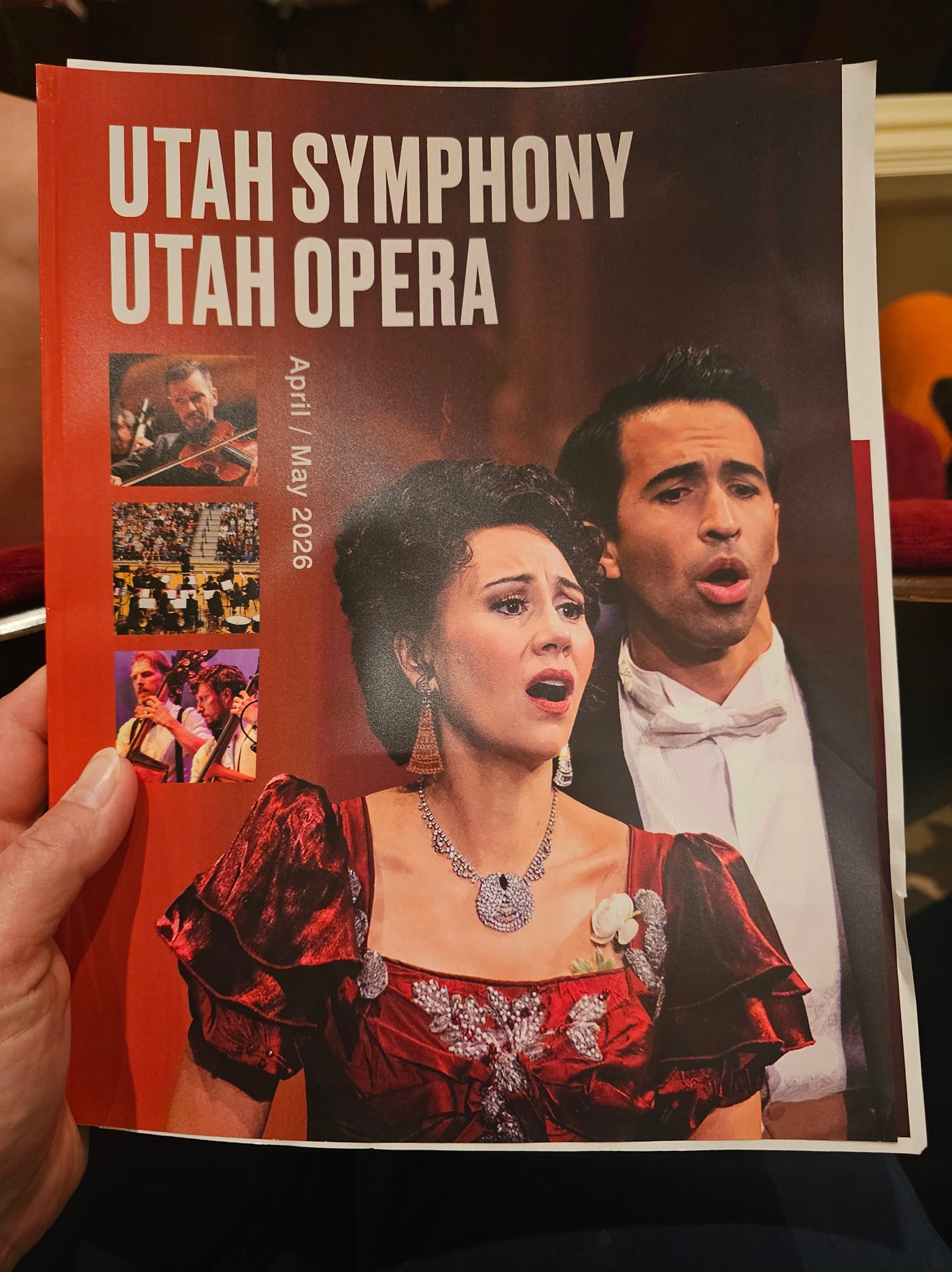
Of Utah Opera’s offerings this season, I had most looked forward to seeing La Traviata because I hadn’t seen a live production before. My only prior experience had been seeing Zeffirelli’s 1982 film version starring Plácido Domingo and Teresa Stratas, which I saw because my mother and grandmother were fans, thus making it a long-standing favorite of mine as well. I attended Monday night’s performance, and my eager anticipation was rewarded with an exceptional production!
Courtesan Violetta Valéry (Lydia Katarina) has been suffering from consumption, but her health has improved enough to host a party alongside her patron Baron Douphol (Christopher Clayton). Flora Bervoix (Julia Holomon), Marquis d’Obigny (Rodney Sharp II), and Gastone de Letorières (Aaron McKone) arrive late, with Gastone’s friend Alfredo Germont (Isaac Hurtado) joining them as an uninvited guest. Alfredo has admired Violetta for over a year; for him, the party represents a long-awaited opportunity to declare his love for her. Amid some weakness from her illness, Violetta agrees to meet with Alfredo the following day, although she contemplates how falling in love might jeopardize the freedom she has enjoyed. Violetta enters into the romance, and the couple move to a house in the country. Without the patronage of her former life, and with Alfredo lacking any independent wealth, the pair quickly find themselves struggling to meet accumulating expenses. Violetta enlists her maid Annina (Stephanie Chee) to liquidate her lady’s personal possessions to pay the debt. Learning this news spurs Alfredo into action, endeavoring to earn the money to repay Violetta. Alfredo’s father Giorgio (Weston Hurt) arrives at the house, intending to speak to his son, but catching Violetta alone, he entreats her to leave Alfredo. Abandoning the romance would remove the dishonorable cloud that courting a courtesan has caused, and Alfredo’s sister could then contract an honorable marriage for herself. Out of her deep love for Alfredo, Violetta agrees to the excruciating sacrifice that Giorgio demands. She agonizingly pens a farewell letter to Alfredo and flees back to Paris, leaving him to believe she betrayed him for her old way of life. This fatal misunderstanding propels a scorned and humiliated Alfredo to publicly insult Violetta at a Parisian masquerade, only to learn too late the truth behind her sudden departure. He lovingly returns to her side for her final fragile moments.
Katarina, Hurtado, and Hurt achieve exquisite vocal chemistry that thoroughly embodies the interwoven depth and range of their characters’ emotions. Collectively, their voices exude formidable power while remaining supple and pristine. They flawlessly glide over the notes and immerse the audience in the unfolding drama. Katarina’s spinto qualities add a fierce edge to her portrayal of Violetta in the opening party scene and later masquerade. She astutely softens those edges, adopting a velvety, introspective tone for “Ah, fors’è lui,” the Act I aria in which she contemplates whether or not to accept Alfredo’s love. Katarina’s singing in the opera’s final scene adeptly delineates each shade of Violetta’s emotional spectrum–encompassing her desolation at having sacrificed her true love, fatalism toward her imminent solitary death, ecstasy at Alfredo’s return, momentary transcendence of her physical limitations, and quick final demise. Hurtado sustains a delightfully tender tone throughout the opera. His phrases consistently sound effortless and free, never strained, as he moves seamlessly through the passaggio. He shines in his interpretation of “De’ miei bollenti spiriti” at the beginning of Act II, beautifully conveying the intimacy of Alfredo’s thoughts as he reflects on how Violetta’s love has transformed him. Hurt’s warm baritone and fluid phrasing cast Giorgio as lyrical and conversational. His request of Violetta in Act II–“Pura siccome un angelo”–sounds like a protective father’s perfectly reasonable plea rather than an exclusively malicious move. This leading trio’s superb vocal performances and emotional authenticity render devastatingly palpable the conflicting themes of societal expectation, painful sacrifice, and tragic fatalism.
Utah Opera’s production of La Traviata was perfectly riveting from beginning to end. Experiencing a performance of this caliber was a profound privilege. To explore their upcoming season and ensure you don’t miss their next masterwork, visit Utah Opera.
 The Good Life
Leave a comment