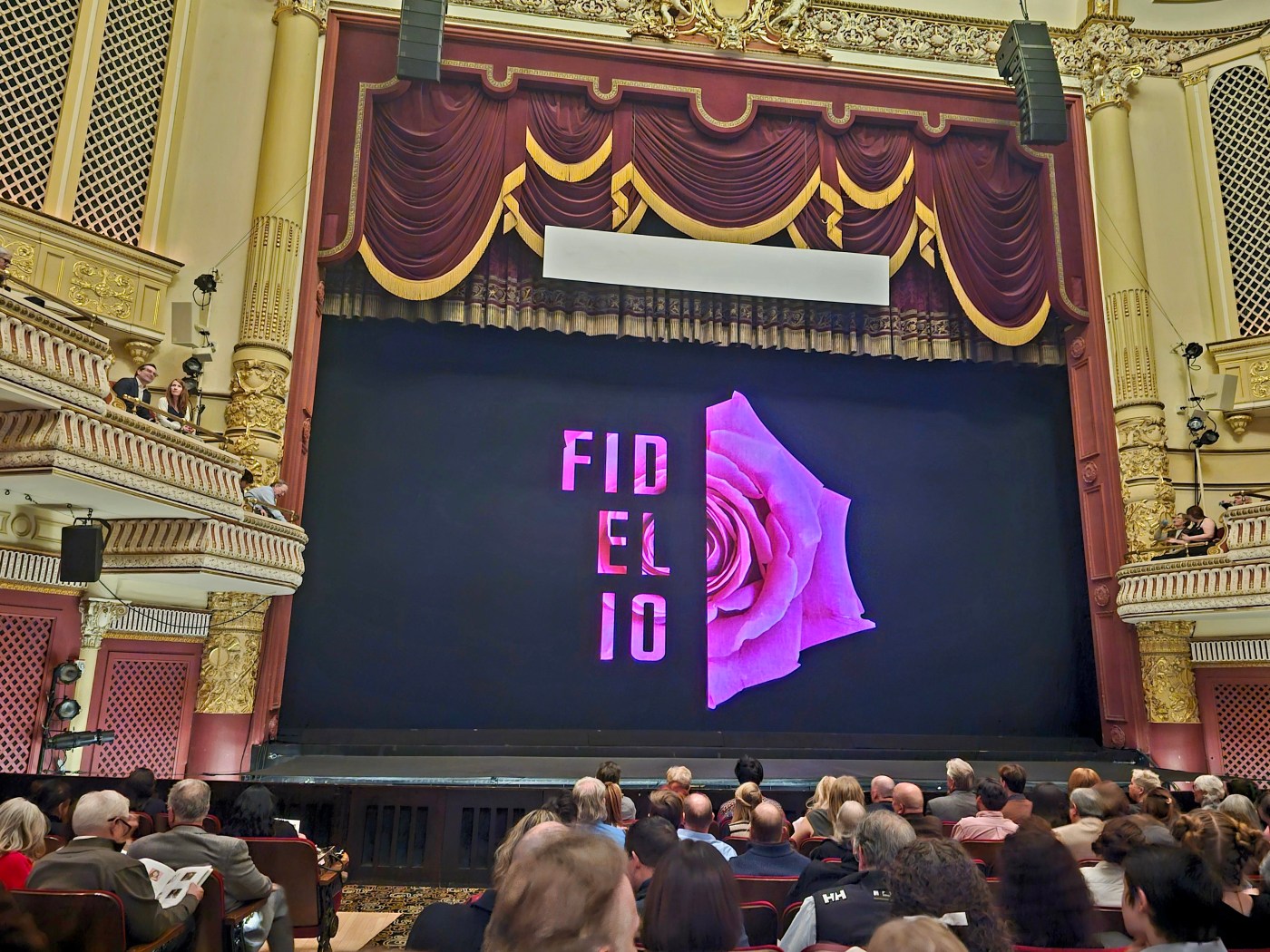
Utah Opera’s production of Fidelio opened at Capitol Theatre on Saturday night. I hadn’t seen this opera before, so I was excited to go and experience something new. Under the direction of Tara Faircloth, who also directed Utah Opera’s productions of The Little Prince in 2019 and 2024, this production updates Beethoven and Sonnleithner’s work to include new English narration and compelling contemporary sets. A formidable cast delivers stirring vocal performances that infuse the characters and drama with emotional intensity.
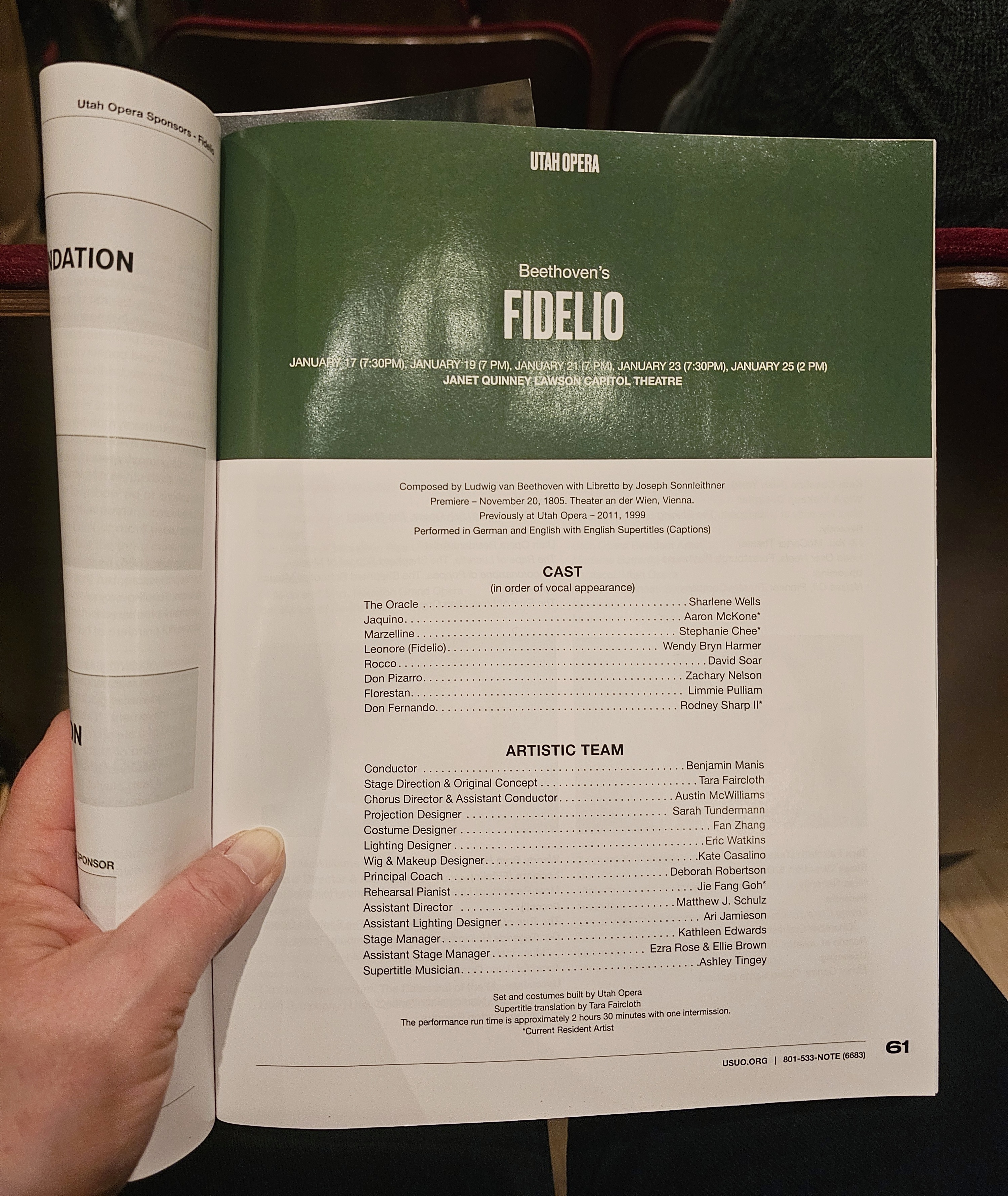
Fidelio unfolds like a fable or parable in which there is a stark juxtaposition between darkness and light. Rocco (Raymond Aceto) oversees a local prison where Florestan (Thomas Kinch) has been unjustly incarcerated and harshly treated for his political views. Rocco’s daughter, Marzelline (Stephanie Chee), dreams of a better life, refusing Jaquino’s (Aaron McKone/Joshua Lindsay)* romantic gestures in favor of her infatuation with her father’s new assistant, “Fidelio” (Wendy Bryn Harmer). Unknown to Marzelline, “Fidelio” is actually Leonore, Florestan’s devoted wife, who has come to the prison disguised as a male to free her husband. The prison governor, Don Pizarro (Zachary Nelson), arrives and learns that the Minister of State, Don Fernando (Rodney Sharp II), will be inspecting the prison due to suspicions that Pizarro is illegally holding political prisoners. Enraged, and knowing that the inspection will reveal Florestan’s confinement in the prison’s lower level, Pizarro commands Rocco to kill Florestan. Rocco usually obeys Pizarro, but committing murder exceeds what his conscience will allow. Pizarro determines to kill Florestan himself and orders Rocco to dig the grave. Leonore, as “Fidelio,” overhears Pizarro’s plan and intensifies her resolve to save her husband. At Leonore and Marzelline’s request, the other prisoners enjoy a few moments of sunshine in the yard, and then Leonore capitalizes on working with Rocco to dig the grave — giving her access and opportunity to accomplish her goal.
Fidelio is Beethoven’s only opera, which is a striking anomaly for an otherwise prolific composer. Beethoven genuinely struggled to compose for voice or dramatic narrative, being much more at home composing symphonies. He subjected Fidelio to several revisions of both the music and the libretto. The result is a narrative that lacks cohesion. The opera’s fable-like quality and marked contrast between darkness and light stem from its disconnected elements. The gravity of the prisoners’ circumstances is sharply at odds with the lighthearted romantic subplot and idealistic pursuit of rescuing a loved one. Enduring love as an antidote to intense suffering presents itself as too simple an answer. A director’s task, then, is to develop an artistic concept that integrates the opera’s disjointed elements. Tara Faircloth’s reframed interpretation handles this challenge beautifully. She replaces German narration that has proven awkward for non-native speakers with a newly created role named The Oracle (Sharlene Wells). The Oracle’s lines draw from the words of renowned revolutionaries, thinkers, and poets — selected as cautionary wisdom for the characters’ circumstances and actions. Wells delivers these lines in a rich, resonant tone that complements the high caliber of singing. Faircloth updates the sets and costumes to an indeterminate dystopian time and place that simultaneously allude to the past, present, and future. Prison walls and furnishings are minimal to leave space for digital projections that conceptually convey character and narrative development, with flowers and greenery being the dominant motif. The cumulative effect is visually stunning.
This production features an outstanding, evenly matched cast. Collectively, they excel at strong vocal performances that project beautifully over the orchestra. Their singing embodies warm tones, convincing character portrayals, and conversational phrasing of the lines. Wendy Bryn Harmer delivers an exceptional performance of Leonore’s aria in Act I. Her pacing is exquisite, and she poignantly conveys a range of emotions, encompassing rage, inner courage, and focused determination. The Prisoners’ Chorus is especially tender with effective use of very soft dynamics and precise diction. Thomas Kinch is an emerging heldentenor (a heroic tenor typical of Wagner’s operas) who commands the stage at the beginning of Act II. His rendition of Florestan’s aria is utterly captivating — powerful, emotionally raw, and dynamic. Though a tenor, his voice resonates with rich, robust baritonal qualities. From beginning to end, the singers’ remarkable performances bring Faircloth’s inventive vision to life, allowing both the story and its characters to shine.
Utah Opera’s production of Fidelio runs through Sunday, January 25, 2026. I highly recommend seeing it! Click here for information and tickets.
*Aaron McCone walked the part of Jaquino, but he was unable to sing due to illness. Joshua Lindsay sang the part at the side of the stage.
 The Good Life
Leave a comment