
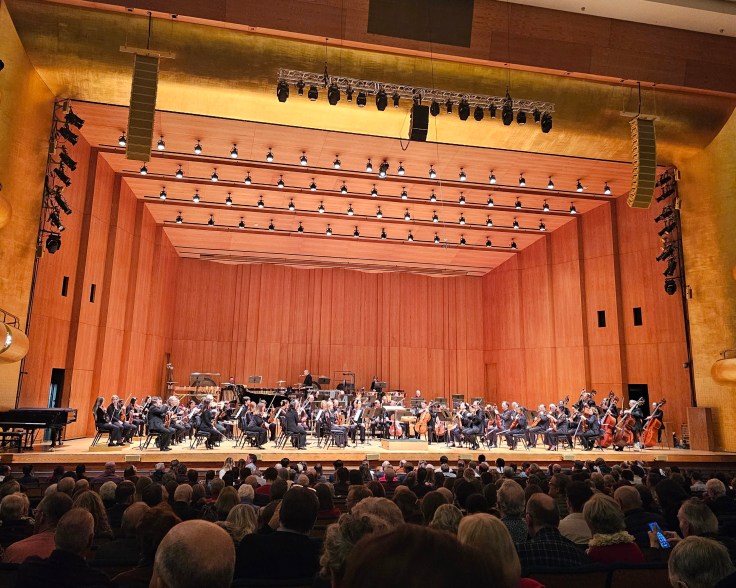
The Utah Symphony delivered a magnificent concert at Abravanel Hall last night! Guest conductor Pietari Inkinen led the orchestra in performing Unsuk Chin’ subito con forza; Ludwig van Beethoven’s Piano Concerto No. 3 in C minor, Op. 37; and Antonín Dvořák’s Symphony No. 7 in D minor, Op. 70. Piano soloist Shai Wosner mesmerized the audience with his exquisite interpretation of Beethoven’s concerto.
Utah Symphony concerts often begin with a short piece to warm up the orchestra and the audience. Unsuk Chin’s subito con forza occupies this place on this weekend’s program. Composed as a short “concert opener” in honor of Beethoven’s 250th anniversary, the piece incorporates elements of the famous composer’s works. I have explained before that contemporary compositions are a challenge for me because of how they experiment with sound. Though I try to keep an open mind, I don’t always enjoy what I hear. Unfortunately, that was the case with this composition. It is chaotic and cacophonous. However, noteworthy elements of the piece that may appeal to other concert-goers include a dramatic beginning, very low notes, and light, shimmering strings.
Disliking the opening piece was thankfully not a sign of things to come, however, and I absolutely loved Beethoven’s piano concerto and Dvořák’s symphony! Soloist Shai Wosner interprets Beethoven’s Piano Concerto No. 3 in C minor very conversationally, allowing each thoughtfully crafted phrase to deliver a tender message. He excels at playing with a light, quick touch — a nice complement to Pietari Inkinen’s conducting style — and he makes excellent use of very soft dynamics. In the first movement, Allegro con brio, the piano enters after a lengthy orchestral introduction and carries the same light melodies that the strings and woodwinds have introduced. The movement’s melodies have a beautiful flowing quality, and Wosner’s playing resembles the cascading sound of a harp. Wosner begins the second movement, Largo, with a delicate touch and deliberate pacing that convey calm and quiet. He makes the piano gently, yet passionately, “speak” each phrase. This part of his performance was a definite highlight for me. The concerto concludes with a third movement, Rondo, in which Wosner makes the piano “dance.” This movement is light and fast, and I liked Wosner’s attack on the keys. Soloist and symphony were perfectly in sync as different pairings of instruments engaged and responded to each other: piano and strings, piano and timpani, and piano and clarinet.
After intermission, the Utah Symphony performed Antonín Dvořák’s Symphony No. 7 in D minor. This symphony successively sounds intensely sad, joyful, glorious, and triumphant. The second and third movements contain some of my favorite highlights. The second movement, Poco adagio, sounds sweet and happy, featuring a bird-like flute, beautiful brass, and excellent synergy among the strings, brass, and woodwinds. The third movement, Scherzo: vivace, has a lilting dance-like quality and intense string passages that I really enjoyed. Symphony No. 7 ends with a fourth movement that allows the strings to be dramatic and bold, and I again noted the contributions of the brass and timpani.
This concert ranks among the best Utah Symphony performances I have attended. The symphony will repeat this program tonight, Saturday, December 13, 2025. Close though it is to concert start time, tickets are still available. Click here or contact the box office at 801-533-6683.
 The Good Life