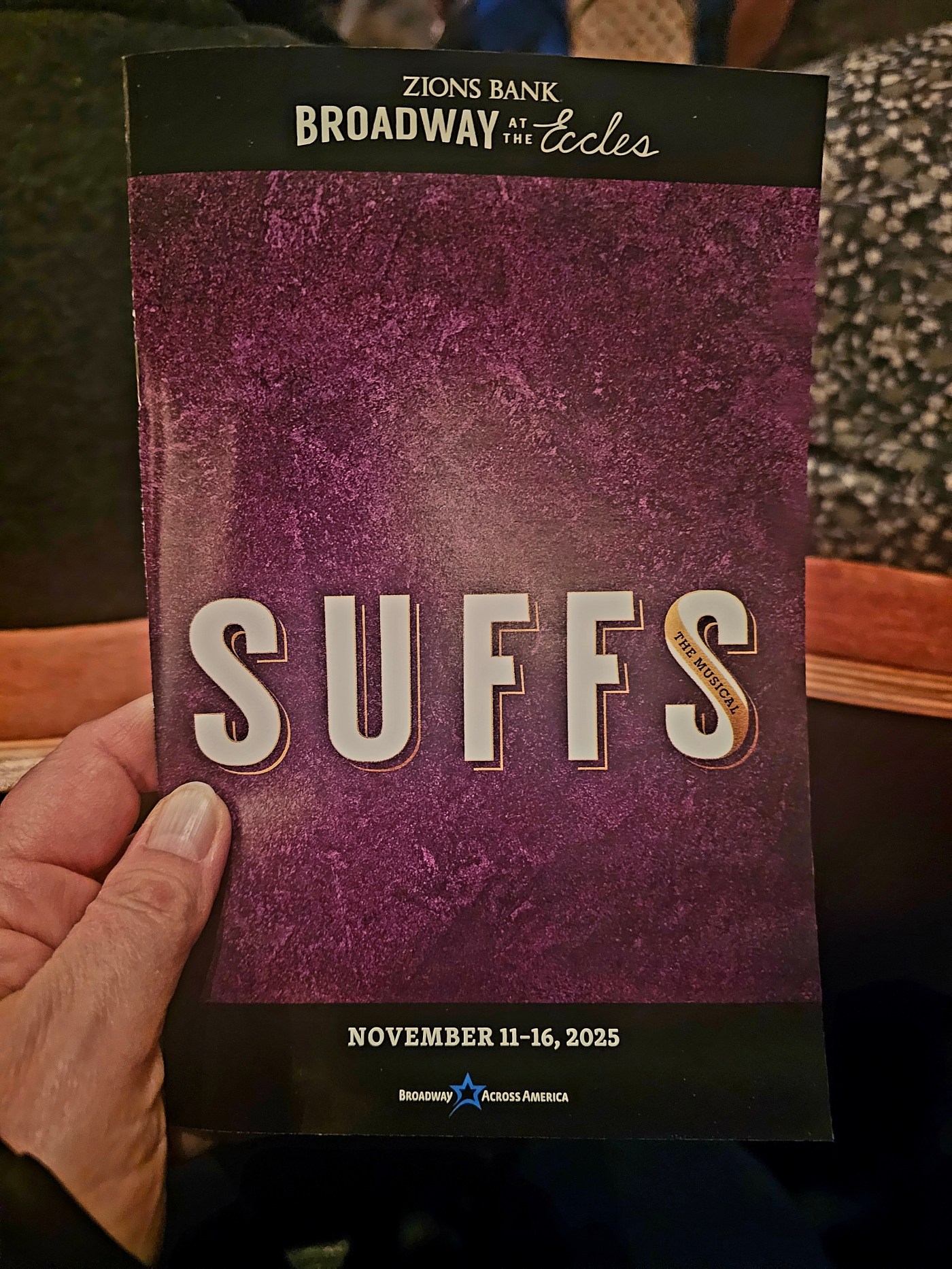
In my 2024 review of the film Young Woman and the Sea, I led with the idea that women of my generation and younger enjoy rights, opportunities, and a relative ease of life that were unavailable to women who came before us. We owe a debt of gratitude to the generations of women who worked and sacrificed long and hard to secure fundamental human rights that allow our participation in civic life, education, and the workforce. What is now status quo for us was once deemed progressive, radical, and dangerous. The 2024 Broadway musical Suffs, which originally premiered Off-Broadway in 2022, explores these themes through the story of the suffragist movement that fought for women’s voting rights, particularly the adoption of the 19th Amendment. Suffs was entirely new to me when I saw it at the Eccles Theater in November, and overall, I loved how powerfully it conveys this story.
Carrie Chapman Catt (Marya Grandy) delivers a speech to the 1913 National American Woman Suffrage Association, arguing that women should be allowed to vote and highlighting how this civil right is consistent with women’s roles as wives and mothers. At the time of the 1913 convention, the push for women’s suffrage has been ongoing for 65 years, dating from the Seneca Falls Convention of 1848. The slow pace of progress, without universally achieving the desired result, frustrates a determined and ambitious Alice Paul (Maya Keleher) who is a generation younger than Catt. Paul proposes a women’s march in Washington D.C. that would coincide with Woodrow Wilson’s presidential inauguration and pressure him into supporting an amendment for women’s suffrage. Catt opposes this idea, preferring to keep the movement refined and genteel, rather than aggressive, and striving to achieve suffrage one state at a time. Undeterred, Paul gathers her own group of women to organize and carry out a march: college friend Lucy Burns (Gwynne Wood), socialite Inez Milholland (Monica Tulia Ramirez), Polish labor organizer Ruza Wenclawska (Joyce Meimei Zheng), and visiting college student Doris Stevens (Livvy Marcus). Questions arise about the role Black women will play in the march. Southern delegations object to having Black women march alongside their white counterparts, so Paul compromises by creating a separate Black delegation that will march at the back. Ida B. Wells (Abigail Aziz) directly challenges this and asserts she will march with her own state’s delegation, putting her at odds with friend and fellow Black activist Mary Church Terrell (Trisha Jeffrey) who favors working within the system to attain rights for Black women. Marchers face some violent opposition and receive derogatory slurs (being called bitches for marching), but they ultimately complete the march. The march sets in motion events that push for the adoption of an amendment that would give women voting rights nationwide: collaborating with NAWSA despite disagreements about tactics, meeting with President Wilson (Jenny Ashman) multiple times only to be met with patronizing lip-service, making personal and social sacrifices for the sake of the movement, actively opposing Wilson’s reelection (Wilson is reelected), founding the National Women’s Party, silently protesting outside the White House, and enduring imprisonment and a hunger strike. Ratifying the 19th Amendment ultimately hinges on the Tennessee Legislature’s vote.
Suffs conveys its story through compelling music and lyrics that echo the sound of Hamilton. (My friend Phaedra and I simultaneously commented on this during intermission. You can read her review here.) The similarity between the two musicals is not a matter of sampling or superficial imitation, but rather their rhythms and melodies share common features that are instantly recognizable. One musical informing the other underscores that women’s suffrage was revolutionary! Every song in Suffs is thought-provoking, and many of them made my list of favorites: “Let Mother Vote,” “Finish the Fight,” “Find a Way,” “Insane,” and “I Was Here.” Marya Grandy and Maya Keleher deliver strong vocal performances that showcase the resonance of their singing voices, and this is a key feature of their convincing character portrayals.
The song “Great American Bitch” may raise eyebrows among conservative audience members. However, the song’s context informs why it is a necessary and significant message. During the women’s march in Washington D.C., a counter-protester addresses Doris with this slur, which she shyly admits to the other women. They quickly reclaim the demeaning word — often used when women assert themselves — and use it as a declaration of their power and autonomy. In this light, the song is a fitting battle cry for what the women are trying to accomplish.
I particularly enjoyed how Suffs portrays the tension between different generations of women. The older, more established generation that Carrie Chapman Catt represents honed a reserved approach that avoids provoking those in power, yet this is not bold or forceful enough for Alice Paul’s younger generation who dares to take more risks. This is a familiar dynamic in civil rights movements as one generation entrusts the next with the fight until a goal is achieved, and ironically, “older” and “younger” are relative terms as those such as Carrie Chapman Catt were once the fiery “younger generation” to move the cause forward. I loved how Marya Grandy and Maya Keleher act out their characters’ conflict, and this tension highlights that a successful movement requires both restraint and radical action. An equally affecting moment happens later in the musical when Phoebe Burn (Laura Stracko), mother of Senator Burn (Jenna Lea Rosen), sends her son a letter just in time before he casts the deciding vote in the Tennesse legislature. Her persuasive words simultaneously lament the limitations she has faced as a woman and argue for her granddaughter to have a better future. They are enough to move her son to vote in the suffragists’ favor, and the performance stirs deep emotion in the audience.
In addition to showing the conflicts and connections among different generations of women, Suffs poignantly depicts the disparity in how the suffragist movement affected Black versus white women. While discussing an acceptable role for Black women in the Washington D.C. march, it is suggested that they may have to wait to attain the same rights their white counterparts are seeking. Abigail Aziz, understudy for Ida B. Wells, renders a powerful response in “Wait My Turn,” a song that effectively lists the hypocrisy of the white women’s tactics. The song and the performance are an impactful reality check.
Once the 19th Amendment is ratified, Suffs looks forward to the possibility of an Equal Rights Amendment and other progressive movements that could stem from what the suffragists started. I found this to be the musical’s shortcoming because it ropes these ideas in quickly at the end without properly developing them, thus making them throwaways or afterthoughts to the primary narrative. The musical attempts to do too much in this regard, and the main plot makes a strong enough statement on its own.
The national tour of Suffs is scheduled to visit many cities around the United States through the summer of 2026. Click here for information about dates in your area. In Salt Lake City, Broadway at the Eccles continues with ‘Twas the Night Before Christmas by Cirque du Soleil, running December 4-14, 2025. Click here for information and tickets. Also, Salt Lake City and its surrounding areas offer many interesting, entertaining, and inspiring productions to add to your holiday celebrations. Check arttix.org to give yourself and your loved ones the gift of live entertainment.

 The Good Life