

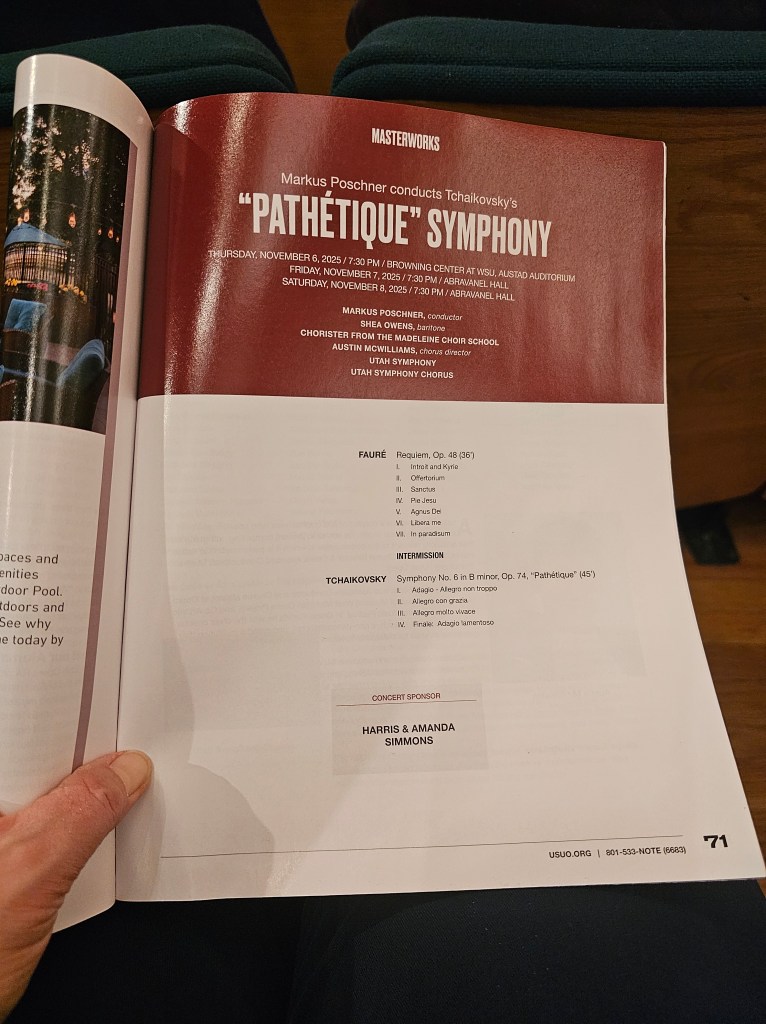
Some concerts are absolute perfection! Such was the case with the Utah Symphony concert last Friday night at Abravanel Hall. The program featured Gabriel Fauré’s Requiem and Pyotr Ilyich Tchaikovsky’s Symphony No. 6 in B minor, Op. 74 -“Pathétique” conducted by Utah Symphony Music Director Designate Markus Poschner. Fauré and Tchaikovsky are among my favorite composers, and I really enjoy Poschner’s conducting style, so it was an easy decision to purchase a ticket for this concert. My decision was made even easier by finding an inexpensive ticket on the main floor of the concert hall. (Helpful Tip: The Utah Symphony frequently offers $26 tickets on each side of the first few rows. The symphony also offers discounts to educators, students, military personnel, patrons under 30 years old, and groups of ten or more. These discounts make quality entertainment widely accessible to the community.)
The evening began with Fauré’s Requiem. Requiem derives from the Latin phrase “Requiem aeternum,” meaning eternal rest, traditionally used in the Roman Catholic Mass for the Dead. Monks often sang the funeral prayers instead of reciting them, and over time, composers created musical settings for the words. Composers such as Mozart and Verdi often leaned into the darker, foreboding themes of the text, emphasizing pleas for mercy against an angry God’s vengeful judgment. Fauré’s Requiem, on the other hand, narrates the trusting soul’s movement toward a tender God and the peace of Heaven. Fauré’s music perfectly communicates this message. A gentle, transcendent, and ethereal quality runs throughout all of the sections, and the Utah Symphony Chorus embodied this with the warm, pristine clarity of its tone. I particularly enjoyed the Sanctus and Agnus Dei portions because of their gradual increase in intensity that sounded radiant. This culminated in the more dramatic Libera Me movement, and baritone Shea Owens brought a nice balance of richness and light to his solo. Jason Brown, a chorister from The Madeleine Choir School, sang an angelic Pie Jesu. The symphony’s accompaniment was superb, and I liked how the organ complemented the strings and harp.
Tchaikovsky’s Symphony No. 6 in B minor, Op. 74 — called “Pathétique” for its deeply stirring emotional qualities that encompass both sorrow and joy — made up the second portion of the concert. Symphony No. 6 includes several recognizable melodies that I enjoyed hearing live, and Markus Poschner wowed the audience by conducting from memory without a score in front of him. I loved the remarkable variety of the first movement: a sweet string melody, complementary woodwinds, a dramatic gong that wakes the audience, fast and furious passages, and very passionate brass melodies. The second movement delights with lilting strings and woodwinds. The third movement entirely captivated me with its energetic, crisp beginning and dramatic, cascading finish. The finale shifts to a somber mood with a measured, slow melody. I loved the intensity and passion in the brass and woodwinds.
The Utah Symphony will continue to engage audiences with a variety of quality programming in the coming weeks. Offerings include a Film in Concert screening of The Wizard of Oz, the music of Motown, the annual Messiah Sing-In, and works by Strauss and Shostakovich. Which one will you enjoy? Click here to learn more.


 The Good Life