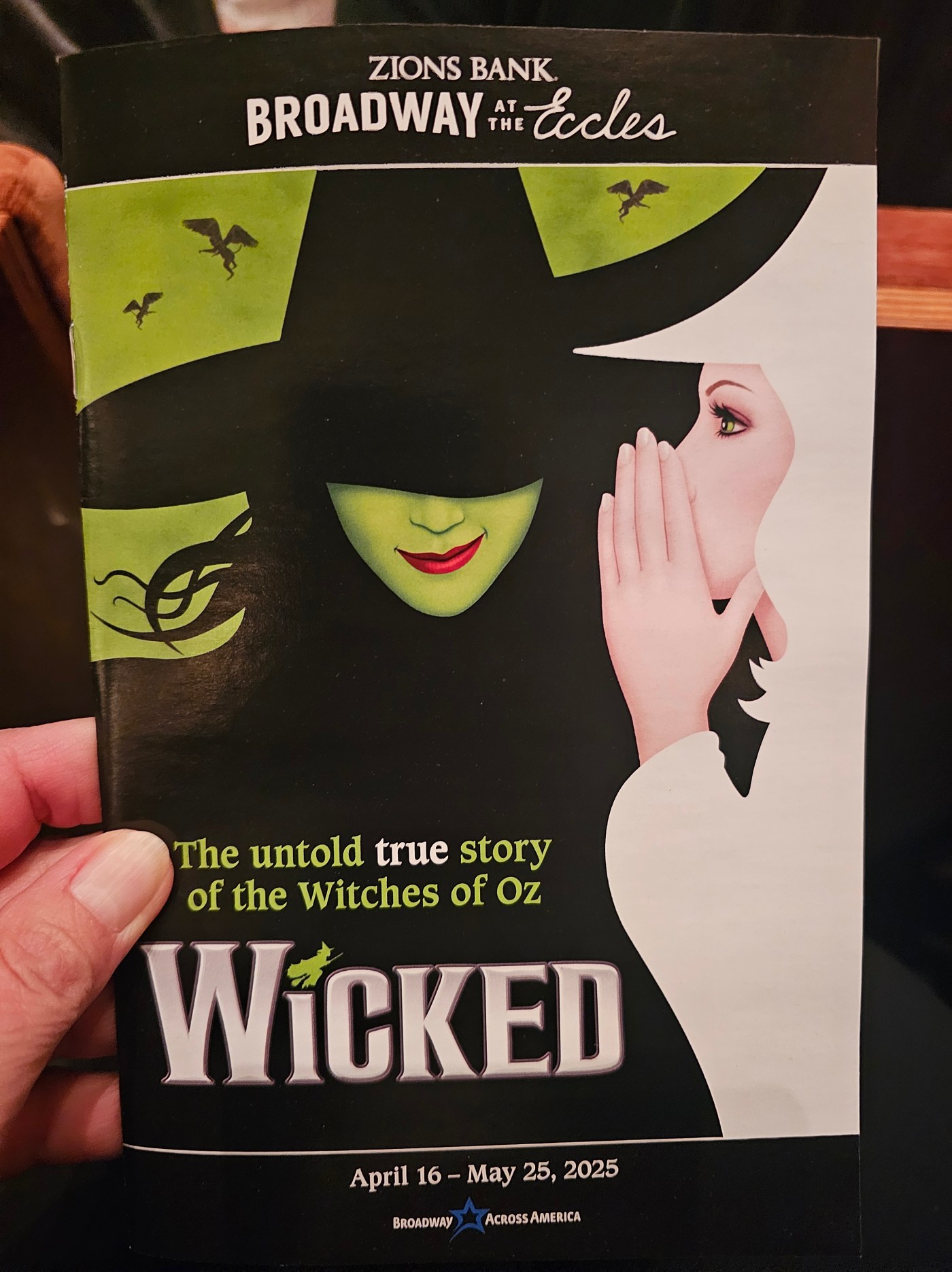
I have a second performing arts confession to make. (You can read about my first confession here.) Despite its immense popularity over the past 20 years, I had never seen a stage production of Wicked until two weeks ago. Seeing and enjoying the movie version that was released in November of 2024 motivated me to purchase a ticket while the Broadway tour is here in Salt Lake City. Friends who have seen Wicked several times over the years have commented that this touring cast was not the strongest they have seen; nevertheless, I enjoyed the performance that I saw, and I opted to see it again last Friday night. The benefit of attending a production more than once is having the opportunity to see different artists in leading roles, as was the case Friday night when an understudy and a standby took the stage for Madame Morrible and Elphaba, respectively. Each of them added dimensions to their characters that I was delighted to see.
Wicked gives a backstory to Glinda (the Good Witch), Elphaba (the Wicked Witch), and other key characters from The Wizard of Oz. The citizens of Oz rejoice as they learn that the Wicked Witch is dead, but someone asks, “Why does wickedness happen?” Glinda responds, “Are people born wicked? Or do they have wickedness thrust upon them?” Accused of having known and once befriended the Wicked Witch, Glinda explains how she and Elphaba met and became the women that they are. Elphaba was an outcast from birth — the product of an illicit affair, born with hideous green skin, and always expected to care for her wheelchair-bound younger sister, Nessarose. No one cared about or considered her talents, desires, or convictions. Glinda, on the other hand, was perfect in every way — physically beautiful, from a prestigious family, and popular among her peers. By all accounts, society deemed her “good.” The two meet at Shiz University where Elphaba has enrolled to look out for her sister, and Glinda has her sights on taking Madame Morrible’s sorcery seminar. The headmistress unwittingly assigns the diametrically opposed girls to share a room. They loathe each other, but loathing gives way to an unexpected friendship. Glinda attempts to make Elphaba over as a “popular” girl, but Elphaba has deeper concerns. She is adept at noticing and speaking up when others, such as Dr. Dillamond and a lion cub in captivity, are mistreated. Her extraordinary magical powers impress Madame Morrible who arranges a meeting with the Wizard, something Elphaba has always wanted. Upon meeting the Wizard, Elphaba realizes that life in Oz is not as it seems. Contrary to being the “wonderful” leader everyone admires, the Wizard uses propaganda to manipulate and oppress. Elphaba works to expose him and finds herself labeled as the enemy. Though friends, supporting Elphaba publicly would jeopardize Glinda’s popularity and influence whereas aligning with the Wizard and Madame Morrible keeps her in “good” standing. She must wrestle with and discover what true “goodness” is.
Several cast members in both performances delivered notable character portrayals.
- Glinda – Austen Danielle Bohmer’s interpretation of Glinda reminded me a lot of Margot Robbie as Barbie. She was delightfully ditzy in her obsession with physical beauty and social status. At times, I wanted her to sing with more power and conviction, but she delivered crystal clear high notes in several of the musical’s challenging songs. I absolutely loved her wardrobe which was a beautiful array of colorful, sparkly cocktail dresses and ball gowns.
- Elphaba – I had the pleasure of seeing both principal Lauren Samuels and standby Carly Augenstein in the role of Elphaba. Both actors delivered solid performances, but Augenstein brought more intensity and emotional depth to the role. Her phrasing, vocal inflections, and vibrato created a compelling character who had me on the edge of my seat for the duration of the show.
- Nessarose – Erica Ito excelled at depicting Nessarose’s emotions, ranging from happiness at being included to bitterness over the consequences of Elphaba’s choices. Ito’s voice had a beautiful resonance that I loved.
- Madame Morrible – Principal actor Aymee Garcia was absolutely perfect for this role! She brought a rich, brassy tone to her singing and speaking that was exactly what one would expect from an assertive headmistress. Understudy Kelley Dorney brought a softer touch that highlighted Madame Morrible’s femininity and grace. I enjoyed seeing the differences in their performances.
- The Wonderful Wizard of Oz – Blake Hammond’s song and dance numbers demonstrated great storytelling that I found enjoyable to watch.
What struck me when I saw the movie version of Wicked, and stayed with me as I watched the stage musical, is society’s tendency to vilify the one who dares to speak the truth and oppose a powerful regime. For me, this is what Elphaba’s character arc represents. The truth she espouses is easy to demonize and dismiss because her physical appearance repels rather than attracts. Her outer “ugliness” leads to the conclusion that she is thoroughly evil, and she should be disregarded, when in reality, her core embodies goodness. She defends others and doesn’t hesitate to do the right thing on their behalf. This theme resonates throughout literature and real world events, which makes it relevant and relatable. Since the movie only portrays the first half of the story (the second half will be released later this year), I enjoyed seeing the completion of Glinda’s contrasting character arc. While she is initially characterized as “good” for superficial reasons, she grows to understand and understand a deeper level of goodness that emulates what Elphaba would do — defend others and make right what is wrong.
Live theater is dynamic and ever-changing. While the Broadway tour of Wicked is in Salt Lake City through Sunday, May 25, 2025, the principal cast has changed. I encourage you to go, but you will have a different experience from either of mine. Such is the opportunity that the performing arts afford us; there is always a chance to see beloved characters and stories interpreted anew. Click here for information and tickets.


 The Good Life
Leave a comment