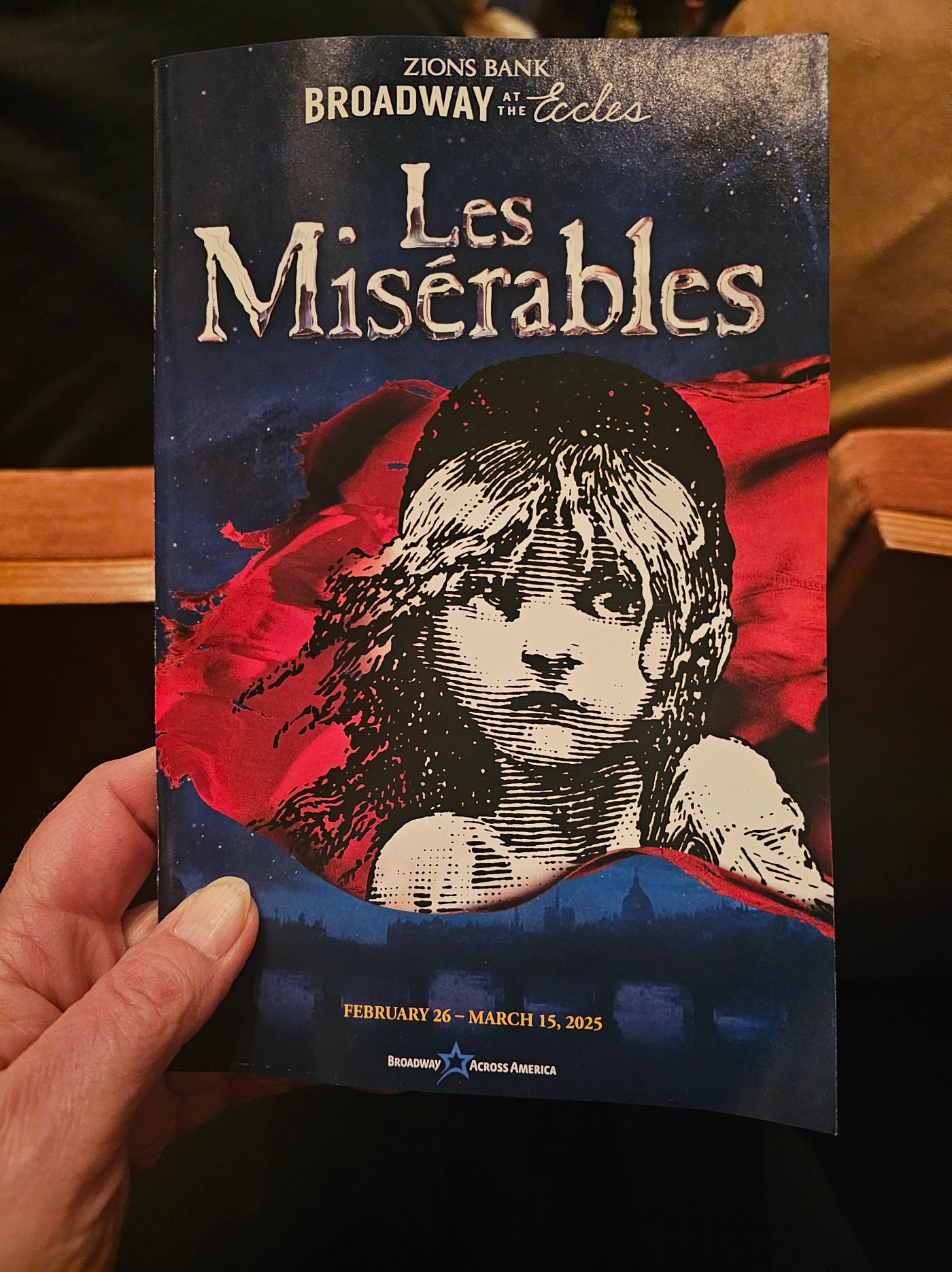
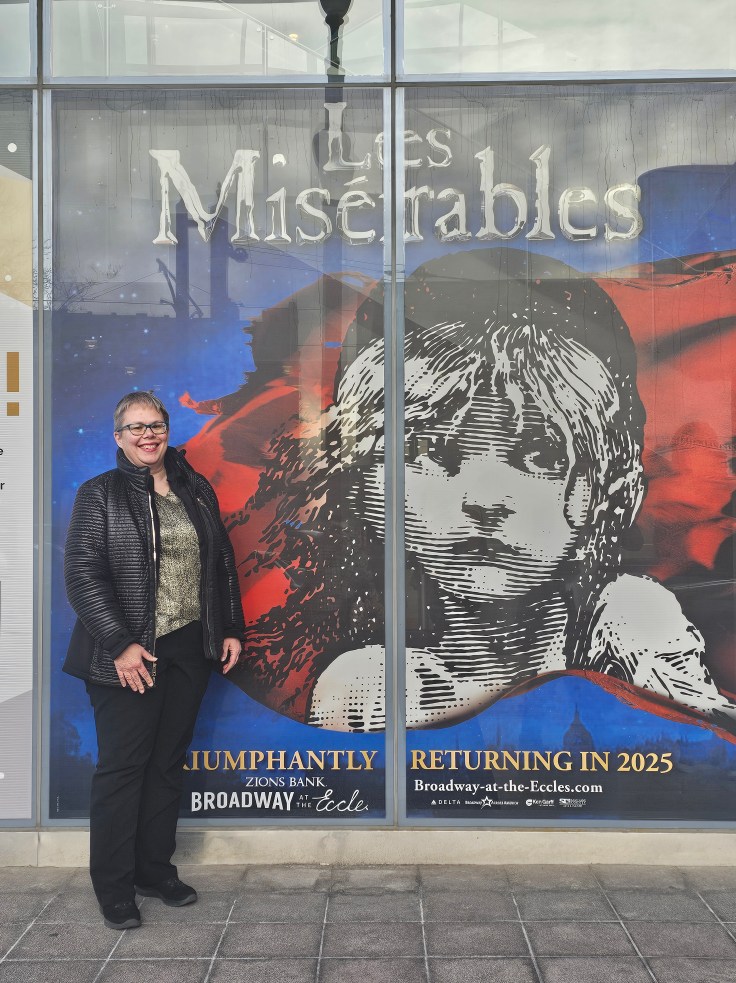
I need to begin this review with a confession. I had never seen Les Misérables prior to Wednesday night. Gasp!! I realize that is a surprising admission from an avid lover of the arts. To make matters worse, I studied French in junior high and high school, and I minored in French in college. I should have seen this musical multiple times by now!! Prior opportunities simply hadn’t presented themselves, so I made a point to correct that situation when I learned that the Broadway tour was coming to Salt Lake City this season. Despite never having seen the full musical, I had been familiar with the iconic songs, usually sung as solos and out of context. I loved finally having the opportunity to put the puzzle together and hear the music in its proper place, and its meaning was deeper for it. I loved aspects of Wednesday night’s performance so much that I had an unrelenting thought urging me to see the show one more time before the tour left Salt Lake City. After work on Friday, I made a last minute decision to buy a ticket for that night’s show. Doing so sublimely complemented my experience Wednesday night.
Set against the June Rebellion of 1832 (a failed insurrection against King Louis-Philippe), not to be confused with the French Revolution of 1789, Les Misérables recounts the transformation of Jean Valjean from a hardened, bitter ex-prisoner (sentenced to 19 years hard labor for stealing bread and condemned as an outcast) to a compassionate benefactor who honors his second chance at life, extending a merciful hand to others within his reach: Fantine, Cosette, Javert, Marius, student revolutionaries, and the destitute in Paris. The narrative poignantly, beautifully presents the juxtapositions of legalism and grace, the rich and the poor, the powerful and the powerless, and condemnation and redemption — ultimately showing the necessity of seeing and responding empathetically to the dignity in every human being.
Given how well-known the storyline, characters, and songs from Les Misérables are, I will highlight the most notable aspects of specific character portrayals, but I want to emphasize from the outset that both performances were magnificent. As spectacular as Wednesday night was, Friday night exceeded it with even greater cast chemistry and authentic emotion. It was absolute perfection!!
- Jean Valjean
Randy Jeter stepped in as an understudy for Nick Cartell on Wednesday night. Jeter is experienced in the role and has received many positive reviews across social media for his performances, but unfortunately, his singing style was not to my liking. He created intensity in a way that sounded tense, forced, and pushed, and he sacrificed clear enunciation of his phrases. This was particularly true in fast-paced sections such as the Prologue, Valjean’s “Solioquy,” and “Who Am I?” I kept hoping that he would relax, open up, and let his phrases soar, but he didn’t do so consistently, making his performance uneven. He did redeem himself in the confrontation with Javert after Fantine’s death. To this he brought fire and energy that were appropriate to the moment. He also delivered a nice performance of “Bring Him Home” and the Epilogue during which he had crystal clear high notes that sounded otherworldly.
Nick Cartell took the stage Friday night, and his performance accomplished everything I had wished Jeter’s would do. Witnessing this difference validated my decision to see the show a second time! Cartell sang the role and conveyed the character with an ease that appeared as effortless as breathing. He sang with vitality, warmth, and clarity throughout, easily conveying Valjean’s mercy and compassion. It was a flawless performance! A particularly memorable moment was his final note of “Bring Him Home” which he sustained for several measures with even intensity, while at the same time making it sound ethereal. This moment was divine!
- Javert: Nick Rehberger portrayed antagonist Inspector Javert, and he delivered powerhouse performances both nights. In particular, his rendition of “Stars” on Wednesday night resounded throughout Eccles Theater and gave me chills from my abdomen to my knees. That isn’t hyperbole; his performance was that moving, conveying Javert’s determination and certainty that he is doing righteous work.
- Fantine: Lyndsay Heather Pearce gave a beautiful, nuanced performance of Fantine that showcased her rich, clear voice. Her interpretation of “I Dreamed a Dream” conveyed Fantine’s heartbreak over life turning out differently from what her younger self had hoped. In Friday night’s performance, Pearce communicated even more of Fantine’s raw emotion than she had on Wednesday night. Also, her depiction of Fantine’s death both nights was particularly moving.
- The Thénardiers: Matt Crowle and Victoria Huston-Elem were absolutely hilarious in their roles as M. and Mme. Thénardier. They expertly overplayed all of their vocal inflections and physical comedy to very humorous effect. They made it abundantly clear that their purpose was to antagonize and exploit everyone they encountered.
- Marius: Jake David Smith’s voice imbued Marius with both tenderness and passion as he courted Cosette and engaged with the revolutionaries. I loved his heartfelt performance of “Empty Chairs at Empty Tables” that conveyed the deep sorrow of losing loved ones in the fight.
- Éponine: I was able to see both understudy Kaitlyn Sumner and regular cast member Delaney Guyer in the role of Éponine. Each of them brought different qualities to the character: Sumner was more straightforward and direct while Guyer was more soulful. I preferred Sumner’s portrayal slightly more, and I absolutely loved her rendition of “On My Own.” She fiercely communicated Éponine’s frustration and sadness over enduring unrequited love.
- Enjolras: On par with Nick Rehberger’s Javert, Christian Mark Gibbs delivered a commanding and compelling performance as Enjolras, the leader of the student revolutionaries. I thoroughly enjoyed his robust, smooth singing voice as his character confidently rallied support for the rebellion. He masterfully led his contemporaries in “Do You Hear the People Sing?”
The sets for this production created beautiful tableaus suggesting the streets, homes, workplaces, and tavern where the action occurred. Additionally, the production incorporated digital projections to create the illusion of the sewers under Paris and the Seine River where Javert commits suicide. I found this to be particularly effective.
Before closing this review, I would like to comment on the seating options I chose for the two performances.
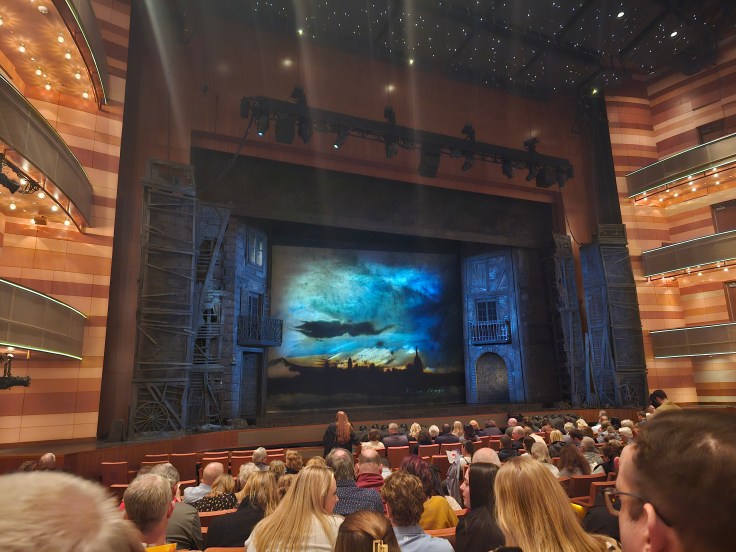
The main floor has been, and likely will continue to be, my preferred place to sit inside the Eccles Theater. I love the proximity to the stage and the intimacy that creates with the performers and the action. This was a perfect spot to experience Les Misérables for the first time on Wednesday night.
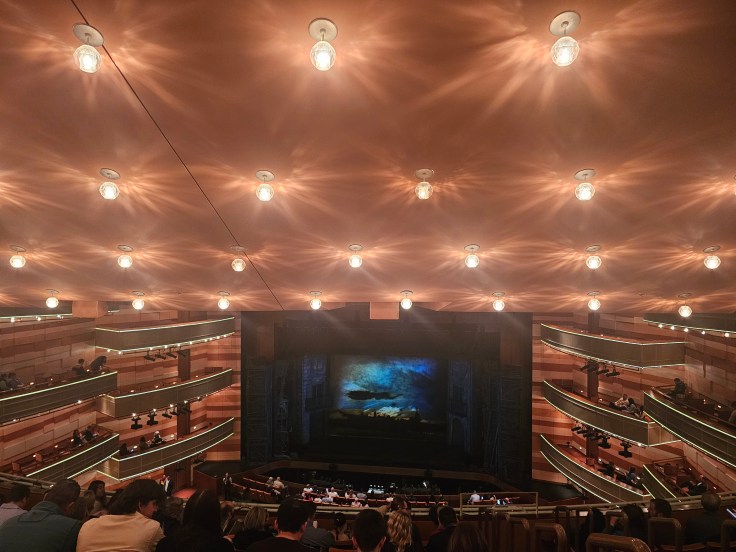
My primary concern in choosing to attend Les Misérables on Friday night was having the opportunity to see and hear the production again, so I chose a budget friendlier option on the second tier. Sitting farther away from the stage loses some of the intimacy of the main floor, but this was still a great seat. I loved how easily accessible it was being an aisle seat on the second row from the top, close to the entrance to the tier. I also learned that the second tier has a lovely mezzanine lobby with concessions, table seating, and easily accessible restrooms. I found the second tier to be less crowded and chaotic than the main floor lobby and lower level. That list of reasons would persuade me to consider purchasing a second tier seat in the future.
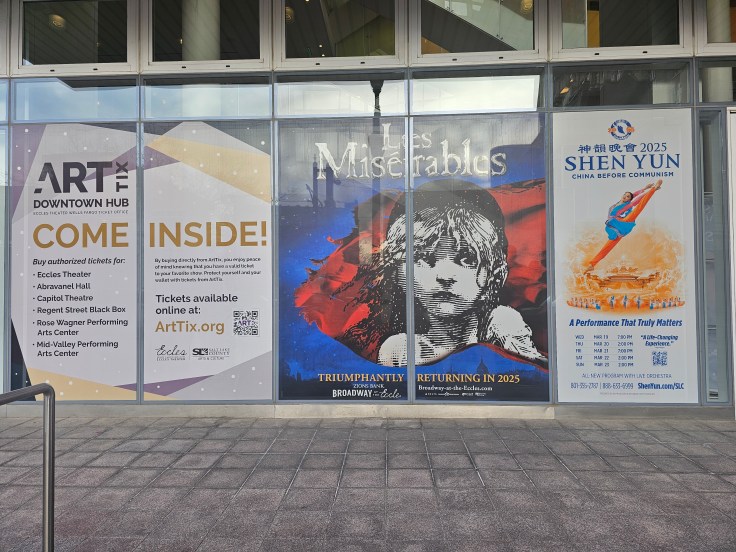
Les Misérables is a masterpiece of a musical that I highly recommend seeing. Wednesday night’s performance was excellent overall, and Friday night’s was thoroughly transcendent. I saw this particular production at the end of its run in Salt Lake City. However, the national tour continues with many dates scheduled in other cities. Click here for more information.
 The Good Life