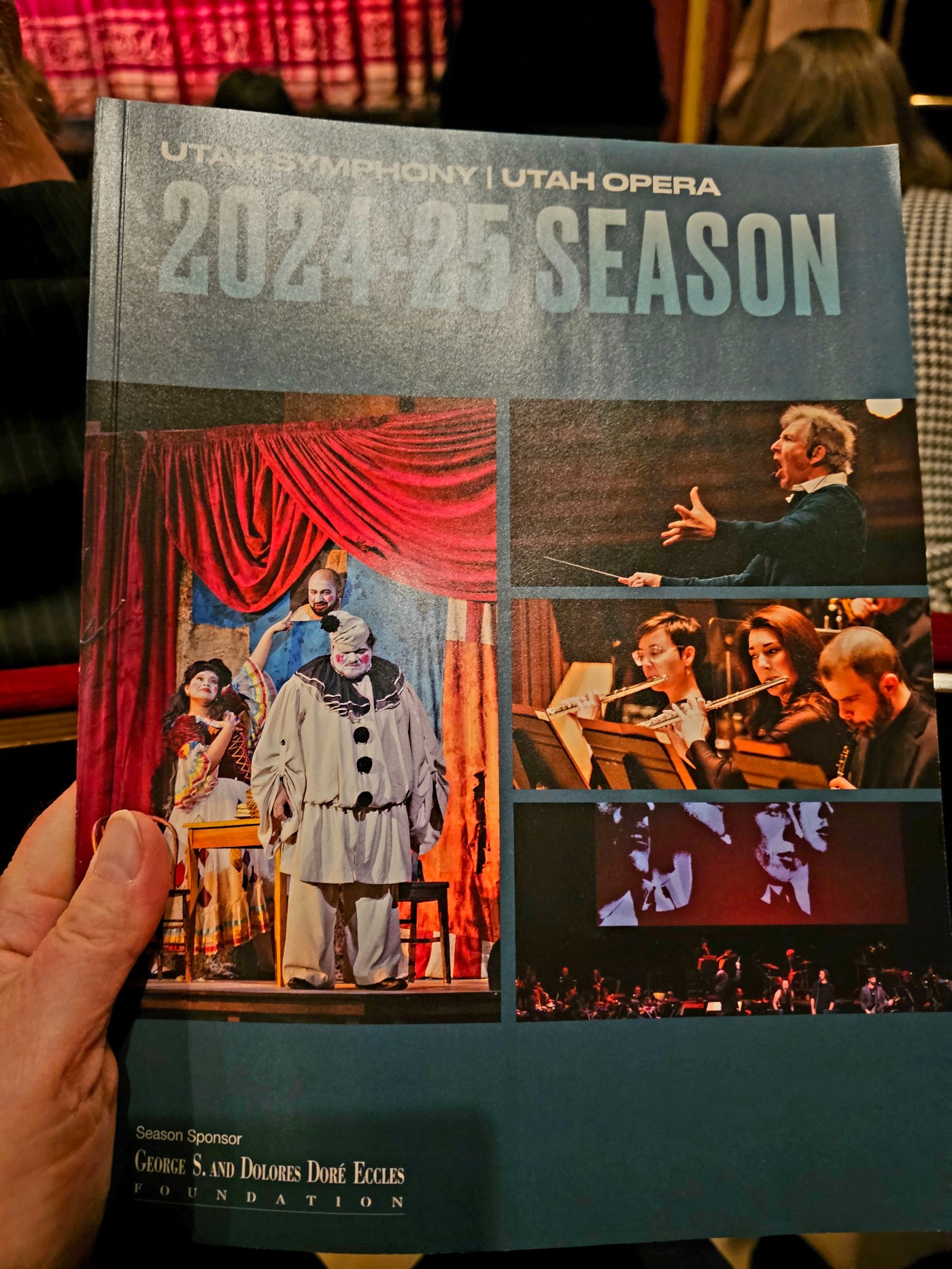
Utah Opera’s production of Pagliacci opened Saturday night at Capitol Theatre, and I was pleased to attend. I first saw Pagliacci in 2018 when I was a relatively new opera-goer and initially familiarizing myself with the genre’s classics, so I looked forward to this opportunity to see it again and reacquaint myself with the music and plot. Running approximately two hours with one intermission, Pagliacci is relatively short, yet it packs a deep examination of character and human desire into its brief time. A shorter opera does not leave the audience short-changed, however, as Utah Opera’s production delivers moving character portrayals, excellent singing, and effective staging.
Standing in front of the curtain, circus clown Tonio (Darren Drone) greets the audience with a prologue, explaining that we will witness a true story: actors, despite the comedy they portray on stage, experience real joy and sadness, just like anyone else. The curtain rises on a rural Italian town where a troupe of comic actors files in, and Canio (Jonathan Burton), the troupe’s leader, advertises the evening’s performance to the villagers. One of the villagers shouts out that Tonio is having a secret affair with Canio’s beautiful wife Nedda (Lydia Grindatto). Canio becomes enraged and threatens violence against anyone who flirts offstage or makes advances toward his wife.
Left alone while the men go to the bar, Nedda expresses how she really feels: the troupe’s way of life limits her, her husband’s possessiveness and brutal tendencies distress her, and she envies the freedom that the birds appear to have. Tonio arrives and confesses his true feelings for Nedda, revealing that he is in love with her, yet his actions are the opposite of affectionate. He forces himself on her and vows revenge when she rebuffs him.
Nedda does actually have a lover, just not Tonio as the audience may have assumed from the first scene. Silvio (Eleomar Cuello), a peasant, visits Nedda once Tonio has left. His behavior toward Nedda is diametrically opposed to that of Canio or Tonio, demonstrating tenderness and concern. The two reiterate their love for each other, and Silvio convinces Nedda to leave with him that night. Tonio returns, ovehears the lovers’ conversation, and out of spite and jealousy, rushes to report the information to Canio, whom he knows will take action. Canio arrives to confront Nedda and her lover, but Silvio escapes undetected, and Nedda refuses to divulge his name. Beppe (Aaron McKone), another of the troupe’s clowns, reassures Canio that he will be able to find out the lover’s identity at that evening’s performance. Left alone, Canio delivers the opera’s most famous aria, “Vesti la giubba” in which he laments his current state: he must play the clown while his heart is actually breaking.
Villagers and the comedy troupe assemble for the evening’s performance. On the stage within the stage, Harlequin (Beppe) serenades Columbine (Nedda) while dismissing her servant Tadeo (Tonio). The pair plots to poison her husband Pagliaccio (Canio). Canio enters the stage unexpectedly, and forgetting his role in the play, he demands that Nedda reveal her real-life lover. As Nedda struggles to stay in character, Canio loses control and exacts his revenge.
Utah Opera’s production contains a characteristic that I always look for in opera specifically and theater generally: a well-matched cast. Each artist on stage portrays his or her own character convincingly and passionately, and their vocal qualities complement each other well. I was particularly excited to see baritone Darren Drone in this production because he had taken part in Seattle Opera’s Jubilee last fall where he exhibited a powerful, smooth sound. Drone brings those same qualities to his depiction of Tonio, and he effortlessly portrays the realism of being a comic whose underlying desires are more complex. Tenor Jonathan Burton matches Drone in this respect as he depicts Canio’s passionate yet overbearing and brutal nature. His delivery of “Vesti la giubba” fiercely embodies a mixture of passion, anger, and despair. Lydia Grindatto and Eleomar Cuellar interact with excellent chemistry in their roles as the ill-fated lovers, and each sings with a beautiful, rich tone. I also really enjoyed this production’s sets which are light, bright, and simple, allowing the cast to move with ease.
Utah Opera’s Pagliacci is a production that I recommend. It runs through Sunday, March 16, 2025. Click here for information and tickets.
 The Good Life
Leave a comment