
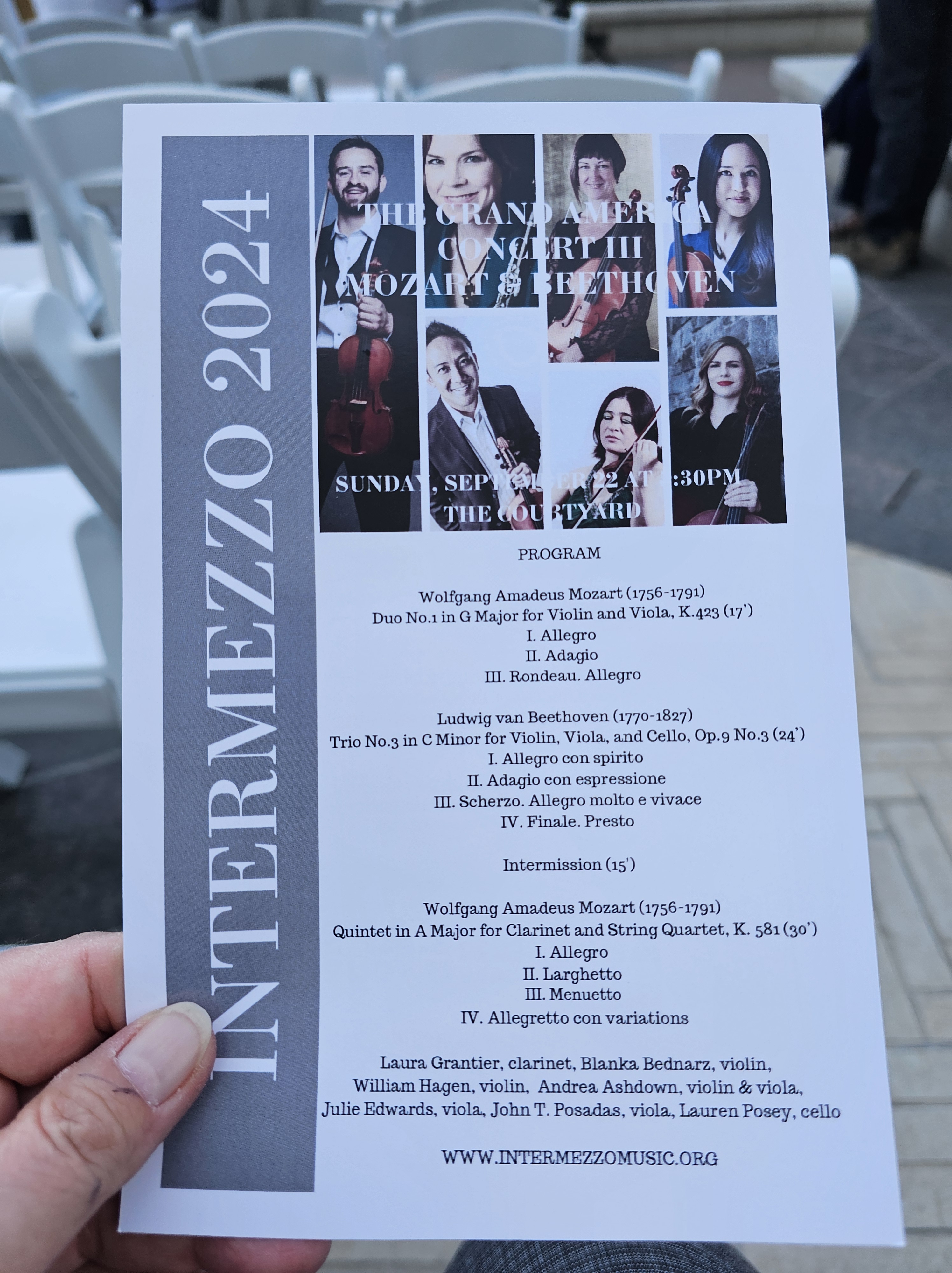
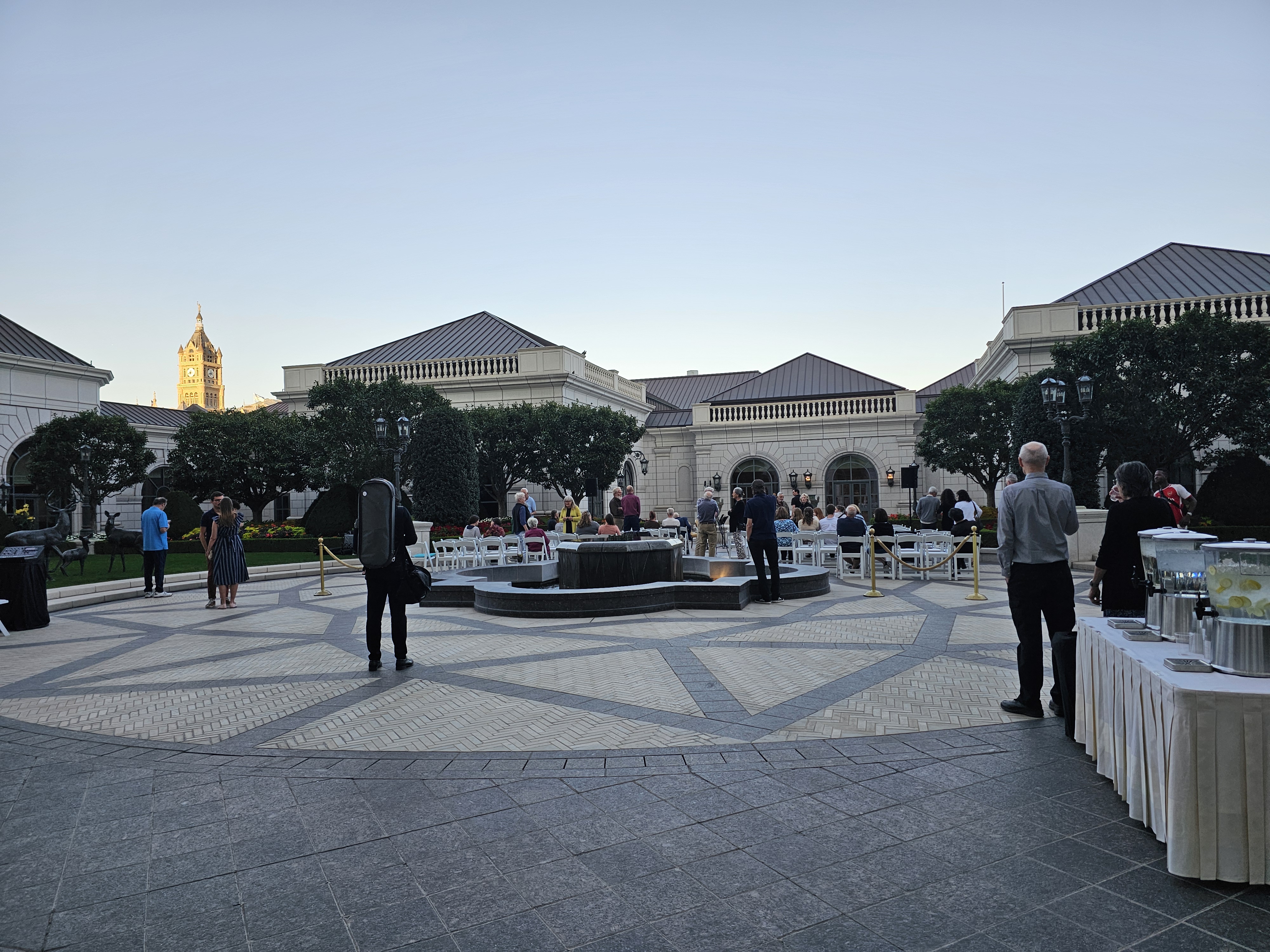
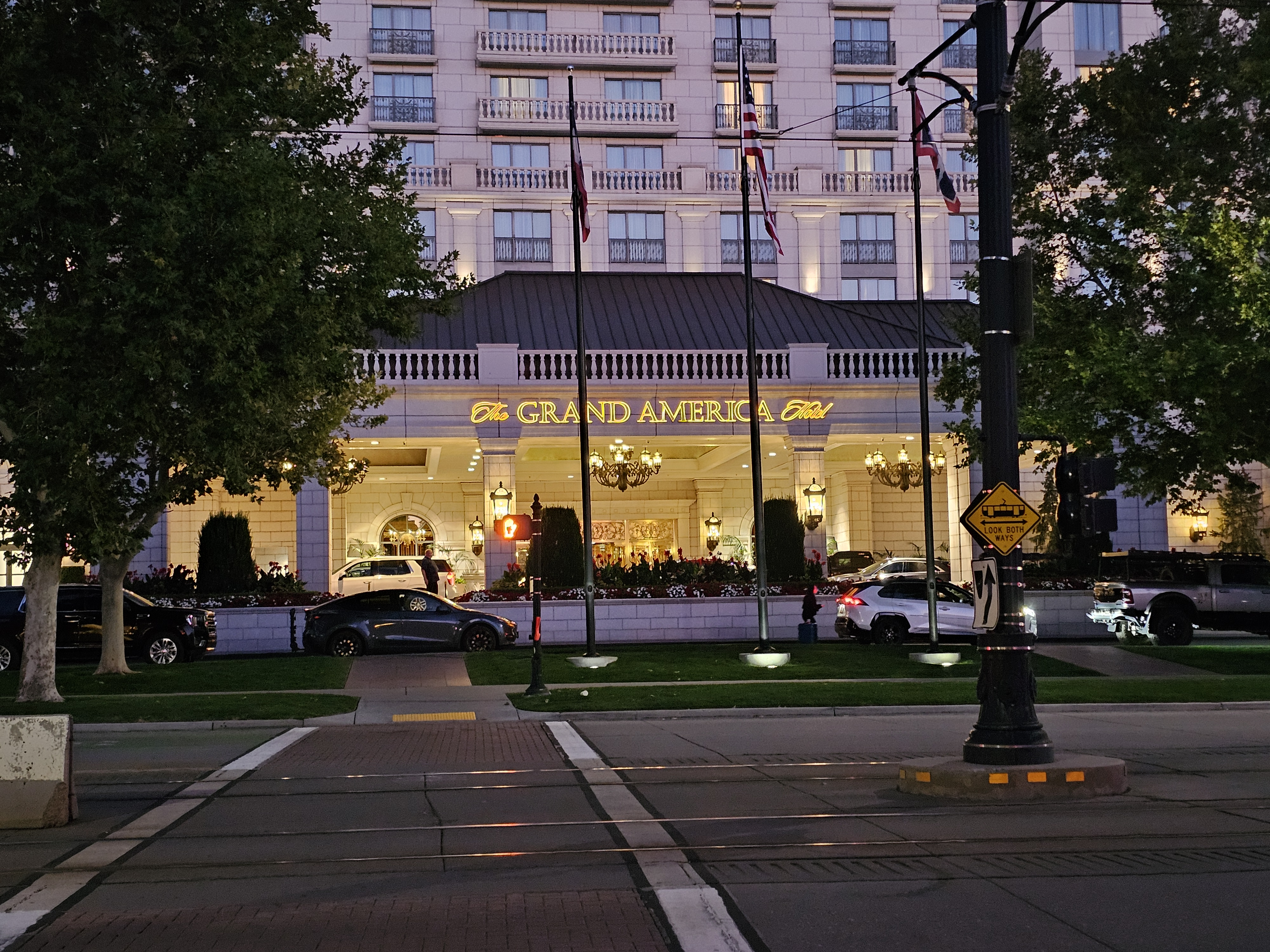
On a breezy Sunday evening with a gentle waterfall flowing in the background, Intermezzo Chamber Music Series held the third concert of its fall season in the courtyard of The Grand America Hotel. Laura Grantier (clarinet), Blanka Bednarz (violin), William Hagen (violin), Andrea Ashdown (violin and viola), Julie Edwards (viola), John T. Posadas (viola), and Lauren Posey (cello) performed works by Mozart and Beethoven that included several outstanding highlights and beautifully demonstrated the complementarity of woodwinds and strings.
William Hagen and Andrea Ashdown opened the evening with Mozart’s Duo No. 1 in G Major for Violin and Viola, K. 423. William Hagen is one of my favorite local violinists because of the vitality, intensity, and artistry he brings to each performance, so I was thrilled to see him on the program. I particularly enjoyed the second and third movements of this Mozart composition. The second, Adagio, gives the violin sweet, flowing melodies to which the viola responds with rich harmony and a beautiful melody of its own. This combination created a lighthearted, cheerful mood that I loved. The third movement, Rondeau. Allegro, increases the tempo with an animated, lively melody that I found to be quite engaging. I appreciated that the movement is emotionally complex, beginning with a sense of joy, changing midway to include strains of sadness, and ending with an optimistic finish. Hagen and Ashdown enhanced their performance of this movement with grit and resonance by digging into the strings, and they gave a brilliant performance of the piece overall.
Next, John T. Posadas (viola) and Lauren Posey (cello) joined Hagen to perform Beethoven’s String Trio No. 3 in C Minor, Op. 9. I especially liked the third and fourth movements of this piece because of their intriguing motifs and the musicians’ vigorous approach to interpreting them. Brisk accented notes pepper the third movement, Scherzo. Allegro molto e vivace, with all three instruments working in sync. Hagen’s performance was impressive yet again, and Posey made the cello part prominent, moving up and down the scale. The final movement, Presto, maintains the intensity of the third, and Hagen kept the performance interesting with well-placed accents on the notes.
Rounding out the program, Laura Grantier (clarinet), Blanka Bednarz (violin), Andrea Ashdown (violin), Julie Edwards (viola), and Lauren Posey (cello) played Mozart’s Quintet in A Major for Clarinet and String Quartet, K. 581. Artistic Director Vedrana Subotic explained prior to the performance that Mozart composed this piece during a particularly difficult year of his life, yet instead of leaning into a melancholic sound, he created an incredibly sublime piece of music that “smiles through the tears.” I absolutely loved this piece because it exquisitely showcases how well woodwinds and strings enhance each other’s sound, something I hadn’t heard to this degree previously. The timbre of the two types of instruments fit together seamlessly. That is a credit both to a beautifully composed piece of music and to the expertise of the musicians playing it. The second and fourth movements particularly captured my attention. The second, Larghetto, evokes a relaxing pastoral scene with a lovely clarinet melody that the strings support. As the movement progresses, the clarinet and first violin play off each other, and I noted the beautiful upper register of the violin. The fourth, Allegretto con variations, highlights each of the instruments in turn, exudes joy with light staccato notes, and allows the clarinet and strings to respond to each other’s sweet melodies. It was a delightful end to the evening!
The final concert in this year’s fall concert series will take place on Wednesday, October 9, 2024 at Libby Gardner Hall on the University of Utah campus. The program will feature William Cano Smit (piano), William Hagen (violin), Sindy Mohamed (viola), and Arthur Hornig (cello) playing music by Mozart and Dvořák. Click here for information and tickets.
 The Good Life
Leave a comment