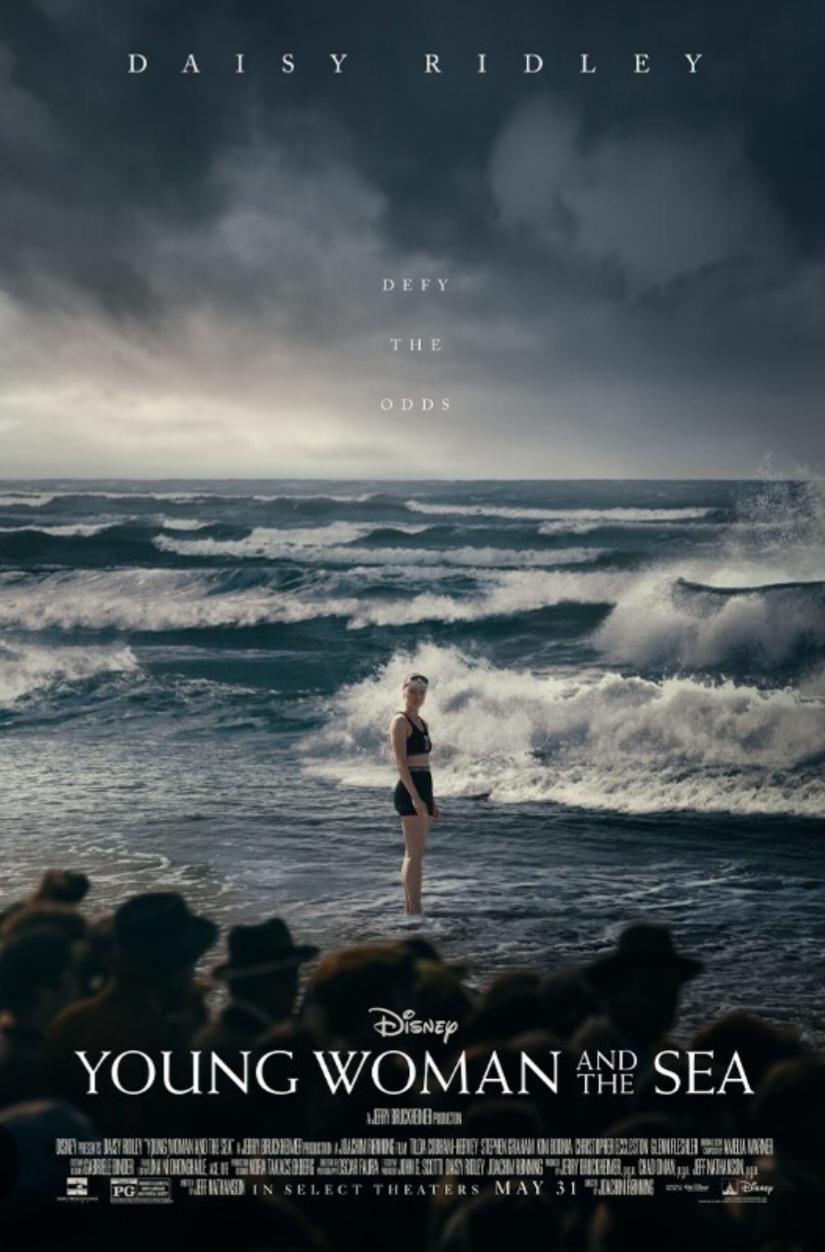
Women of my generation and younger have many rights and opportunities available to us that previous generations of women simply did not have. We risk taking for granted the relative ease with which we move in the world, and we might forget that trailblazers before us had to push against the current to attain the fundamental freedoms we now enjoy. Something as commonplace and natural to human experience as swimming was considered indecent and radical for young women at the turn of the twentieth century. Before Gertrude “Trudy” Ederle could make history as the first woman to swim the English Channel in 1926, she, aided by her mother and sister, had to penetrate the barriers that prevented females of any age from learning how to swim at all and advancing to swim competitively. The film Young Woman and the Sea, directed by Joachim Rønning, offers a compelling and thought-provoking portrayal of Trudy Ederle’s journey from a girl passionate about learning how to swim to a young woman who successfully completes one of the most daring open water swims available.
Young Trudy Ederle (Olive Abercrombie) watches from her apartment window as a fire truck travels along her street toward the New York City harbor. She sees flames and black smoke in the distance, which her mother explains are from a ferry that caught fire. The fire causes hundreds of casualties, many from the Ederles’ German-American neighborhood, and female casualties outnumber the men. Perplexed, Trudy asks her mother why that would be the case. Why wouldn’t the women jump off the ferry and swim 30 feet to safety? Trudy’s mother (Jeannette Hain) quietly admits that the women don’t jump into the water because they don’t know how to swim. Trudy can’t fathom being such a victim. News of the fire coincides with Trudy’s having an intense fever due to a serious case of the measles that neither her parents nor her doctor expect her to survive. Miraculously, though, Trudy emerges from her bedroom, fever broken, famished and asking for food. Her mother then advances the idea that Trudy and her sister Meg (Lilly Aspell) really should learn to swim so that they won’t suffer the same fate as the women on the ferry, but Trudy’s father Henry (Kim Bodnia) won’t hear of it. The girls plead with their father during a family outing to Coney Island to let them swim around the pier as others are doing to win free hot dogs, but he still refuses. In addition to a general aversion to letting his daughters swim, later declaring that there is “no such thing” as women’s swimming, Henry fears that entering the water will exacerbate measles-induced hearing loss for Trudy. (In real life, Trudy did experience hearing loss from the measles that worsened with age and led her to teach deaf children how to swim.) Undeterred, Trudy asserts, “I will swim!” and mercilessly pesters her father into allowing her to do so. He becomes her first teacher, instructing her to swim around the pier as her experience with measles bars her from swimming in a public pool. Trudy’s mother takes it one step further and announces to her husband that she has decided the girls will join a swim team, convincing Lotti Epstein (Sian Clifford) of the Women’s Swimming Association to be their coach. Even on a girls’ team with a female coach, Trudy (Daisy Ridley) has to prove her fitness and fight for a chance to swim, demonstrating the truth of her mother’s description that she is “very strong and has no fear.” Trudy advances, wins competitions, and sets records — all of which position her to be chosen to represent the United States in the 1924 Olympics under the direction of coach Jabez Wolffe. The team fares poorly at the Olympics due to being denied the opportunity to train, and Trudy returns discouraged and disgraced. (This is one moment where filmmakers prioritize creative license over historical accuracy because Trudy Ederle did win medals at the 1924 Olympics.) After the Olympic Games, Trudy wrestles with what her next steps should be, knowing that her father wishes her to marry and learning that Meg (Tilda Cobham-Hervey) has acquiesced to an arranged marriage with a young butcher. Realizing that domestic life is not for her and seeing that young girls appreciate her for creating opportunities for them, Trudy confidently articulates a new challenge: swimming the English Channel, a feat that only five people had successfully completed before her. She proves herself worthy of the sponsorship necessary to swim the Channel and finds herself again under the coaching direction of Jabez Wolffe. Due to several unfortunate complications, Trudy’s first attempt to cross the Channel is unsuccessful. She regroups and makes a second attempt, resolving to “go to England or die trying.”
Young Woman and the Sea effectively engages the audience on multiple levels. On the surface, it is an easily relatable sports drama which invites you to rally around the protagonist and her family as they demonstrate ambition, determination, and resilience. On a deeper level, learning how to swim presents itself as a matter of survival, literally and metaphorically. For the time period that the film depicts, a young woman learning how to swim gains the knowledge to save herself and others, and in so doing, she steps into being more fully human and self-sufficient — a condition that should have been naturally given but that women had to work persistently to attain. Embodying the courage and initiative to empower oneself in the face of numerous obstacles is a theme that I really enjoyed throughout the movie. Beyond its literal significance, learning how to swim as a matter of survival is a metaphor for staying true to one’s passion. If a person deviates from the route they are supposed to be on in life — the route that brings them authentic joy — they will drown under others’ expectations. Cast members deliver superb performances that bring all of these ideas to life on screen. I particularly enjoyed Daisy Ridley as Trudy, Jeannette Hain as her mother, and Sian Clifford as Lottie Epstein. I recommend seeing this film if you can. Check your local listings to see where it is playing.
 The Good Life