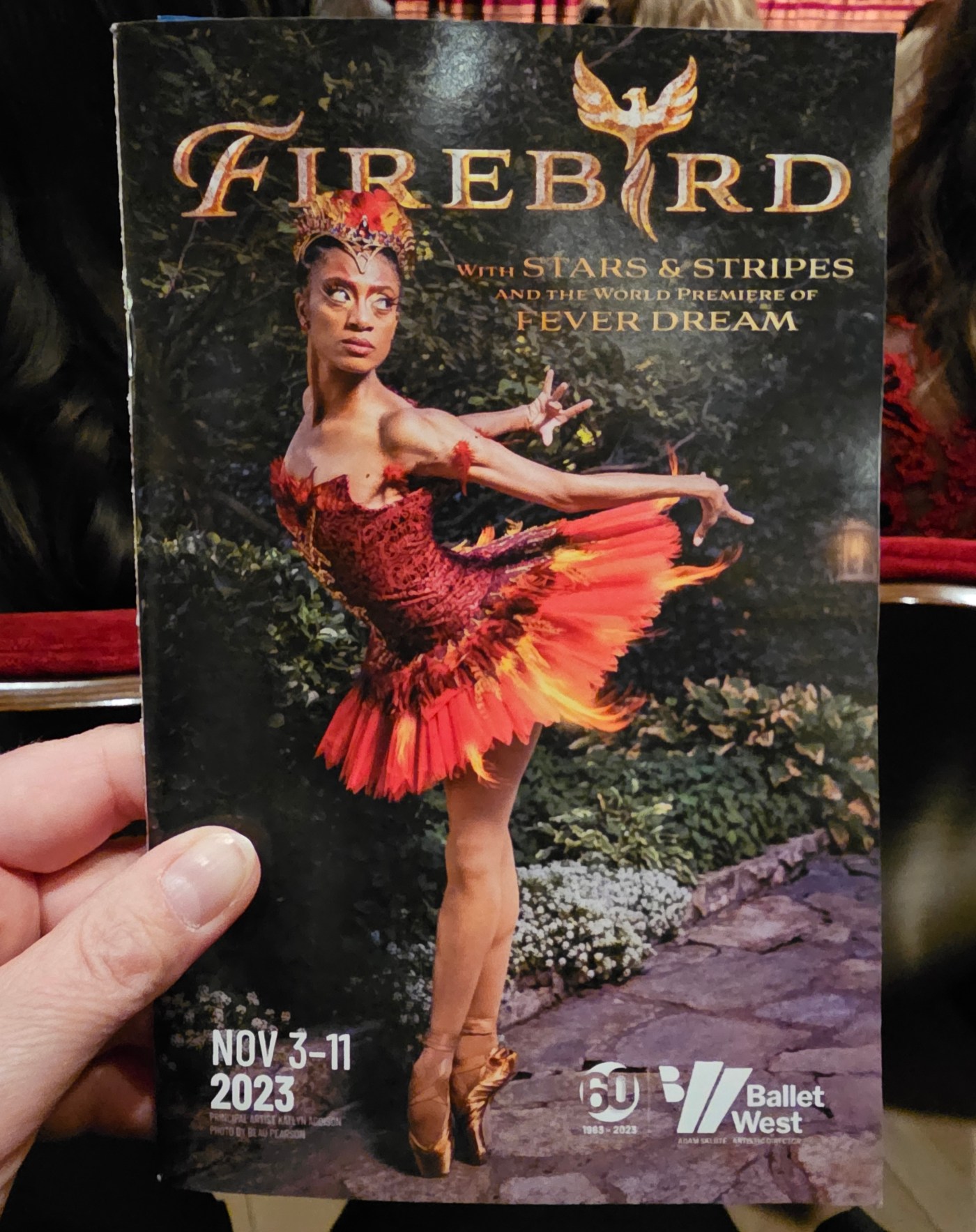
Ballet West continued its 60th anniversary season with a mixed repertoire program titled Firebird that included three shorter works: Igor Stravinsky’s The Firebird, choreographed by Willam Christensen; the world premiere of Fever Dream, composed and choreographed by former Ballet West Demi-Soloist Joshua Whitehead; and George Balanchine’s Stars and Stripes, set to music by John Philip Sousa, arranged by Hershy Kay. I attended the final performance a week ago, and I enjoyed many notable moments in all three works.
The evening began with Stravinsky’s The Firebird, the music for which opens with a slightly syncopated bass line that resembles jazz and signals a more modern composition. The ballet’s narrative is taken from a Russian fairy tale. Sinister King Kostchei (Dominic Ballard), an evil magician, holds a group of princesses hostage. The young Prince Ivan Tsarevich (Hadriel Diniz) enters the king’s garden, and while he is there, a magnificent, magical red bird (Katlynn Addison) flies down to feed on the garden’s golden apples. Ivan captures her but then sets her free. In appreciation, she gives him one of her beautiful red feathers, telling him to wave it to call her if he is ever in trouble. As the Firebird flies away, the king’s gates open, allowing his 13 captive princesses to come out and play in the moonlight for one hour. The loveliest among them, the Tsarevna (Emily Adams), captivates Ivan. They dance together and then part with a vow of love when the princesses must return to the castle. Ivan, intent on saving his beautiful princess, attempts to open the king’s gates, but monsters overtake the garden. King Kostchei appears and begins turning Ivan into stone. Ivan waves the Firebird’s feather, and she arrives to rescue him. In so doing, she reveals a great egg that is the source of Kostchei’s power. Ivan breaks the egg which destroys Kostchei and sets the princesses free. The Firebird ends with the princesses reuniting with their knights, whom Kotschei had turned to stone, and Ivan marrying Tsarevna in a grand ceremony.
Katlynn Addison danced the part of the Firebird with exceptional strength and grace. I particularly enjoyed her fluid turns in which, from head to toe, her body rotated in seamless movements. I also loved that her facial expressions conveyed her character’s range of emotions from concern to relief. The scene in which the princesses dance in the garden, and Ivan first encounters the Tsarevna, was particularly beautiful because of its pastel color palette that balanced peach and light green costumes. The couple and the other princesses smoothly wove in and out of dancing the scene’s romantic choreography with each other. Emily Adams gracefully extended every movement. Dominic Ballard as the Kotschei, as well as the corps dancers taking the part of the monsters, delivered mysterious, energetic performances that added a sense of fun, albeit a little sinister. I found the final scene depicting the reunion of the knights and princesses and the marriage of Ivan and Tsarevna to be especially captivating because of its regal costumes and choreography that communicated freedom, light, and joy.
The second work on the program was Fever Dream, a non-narrative work by former Ballet West Demi-Soloist Joshua Whitehead. The piece takes the audience through a dreamlike world that delves into the subconscious mind. The dreamer is torn between wanting to escape the mundane aspects of his everyday life and the appeal of the dream world. The music is atmospheric rather than melodic, conveying a steady pulse that resembles either a heartbeat or firing neurons. It portrays the brain and body going through different thought patterns and activities in a day, responding to different stimuli. The fresh choreography incorporates ballet, contemporary, an hip hop movements.
I really liked that the choreography reflected what was happening in the music. Similarly, I liked that the costumes were casual, everyday clothing that evoked mid-twentieth century styles and communicated that this ballet could be about anyone. The piece started with an ensemble whose leg, feet, and hand movements pulsed in time with the music, and the dancers moved smoothly through line and circle formations. A male duet followed in which the dancers beautifully mirrored each other, and one seemed to be prompting the other. The piece included a more traditional pas de deux that evolved into another couple joining them. I found this section to be particularly beautiful because of the dancers’ fluid movements and sensational lifts.
The final piece on the program was George Balanchine’s Stars and Stripes, set to several of John Philip Sousa’s marches, arranged by Hershy Kay. A joyful, patriotic piece, it exuded both nostalgia and hope. It is structured as a series of Five Campaigns or movements, each with an ensemble of dancers that creates a stylized parade.
- First Campaign: “Corcoran Cadets” – This campaign included a female ensemble dressed in “red” (bright pink tulle), white, and blue military costumes. A baton twirler (Kristina Pool) led this regiment.
- Second Campaign: “Thunder and Gladiator” – This campaign included a second female ensemble, also dressed in military costumes, but their tutus were periwinkle blue. A bugler (Amy Potter) led this regiment. I loved the striking color choices for the costumes in the first and second campaigns because they evoked patriotism while also being creative.
- Third Campaign: “Rifle Regiment” – This campaign featured a male ensemble depicting soldiers. I loved their incredibly precise, intricate footwork as well as passing grands jetés that crossed the entire stage.
- Fourth Campaign: “Liberty Bell” and “El Capitan” – Jenna Rae Herrera and David Huffmire danced a beautiful pas de deux, followed by a series of alternating solos from each of them. Their energetic performances utilized the entire stage, and their faces beamed with joy. As noted in my review of Ballet West’s Dracula, Herrera is one of my favorite Ballet West dancers, so I particularly enjoyed their section of this piece.
- Fifth Campaign: “Stars and Stripes” – The entire company took the stage for a spirited finale. I loved the choreography en pointe that resembled soldiers marching and a Rockettes-style kickline.
I really enjoyed the variety in this mixed repertoire program as each piece offered distinct music, costumes, and choreography. With the holiday season fast approaching, Ballet West moves on to stage its annual fan favorite, Willam Christensen’s The Nutcracker. The production runs from December 8-27. Click here for information and tickets.
 The Good Life
Leave a comment