
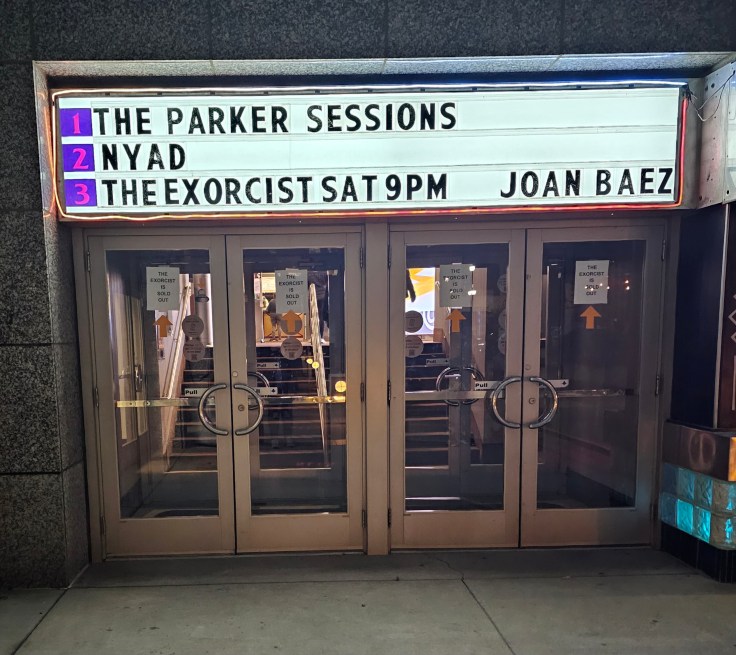
I have a long-standing aversion to horror films that stems from negative experiences watching horror movies when I was younger. However, when I learned that this year marks the 50th anniversary of The Exorcist and local theaters would be showing it during October, I decided that it would be worth it to see this classic on the big screen. I have not read the novel on which the movie is based — my aversion to horror extends to literature as well as film — but I gained some prior knowledge of key moments in the plot and listened to online commentary from real Catholic Church exorcists who have described the work that they do. Consequently, I went into the film somewhat prepared for the battle between good and evil that would be dramatized.
The Exorcist differs from other horror movies in that it develops as a slow burn that carefully establishes character and plot rather than relying on quick and easy techniques to elicit immediate fear from the audience. The film begins with a prologue set in the desert of Northern Iraq, near the ancient city of Ninevah. An older Jesuit priest, Father Lankester Merrin (Max von Sydow), is participating in an archeological dig during which he finds a greenish, gargoyle-like amulet resembling the Mesopotamian demon Pazuzu. This discovery sets in motion the tension between good and evil that will occupy the rest of the film. During these opening scenes, the audience also sees Father Merrin’s physical vulnerability as his hands shake under the strain of the desert heat, and he takes medication, presumably for his heart.
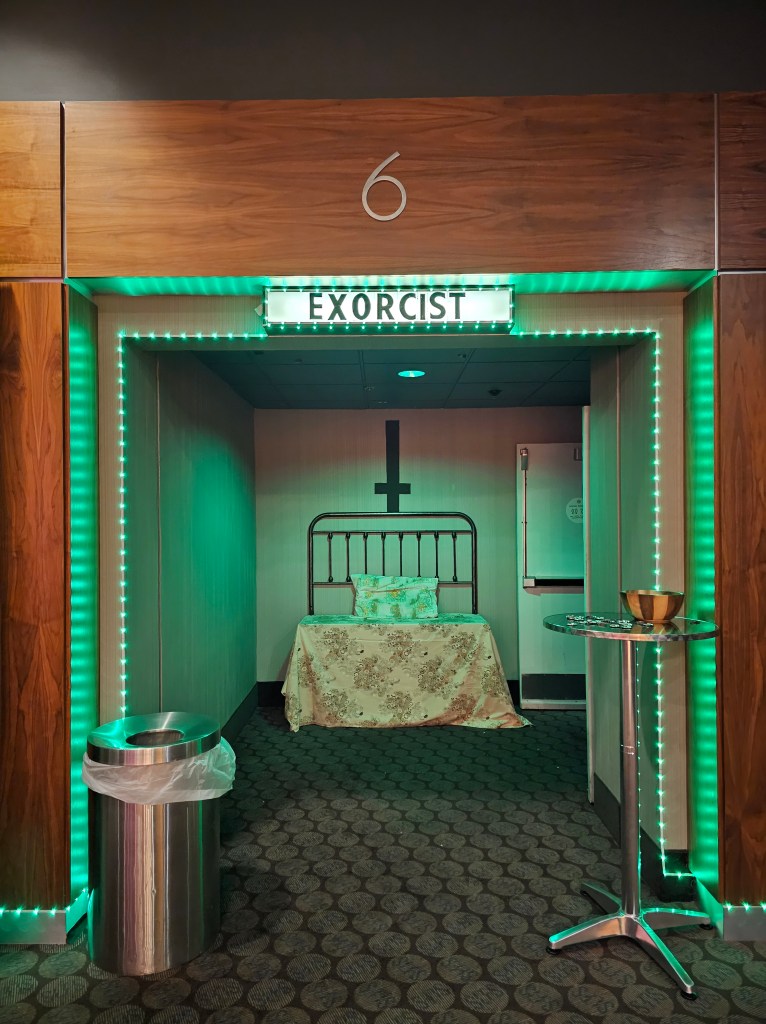
The scene shifts to the Georgetown neighborhood of Washington D.C. where actress Chris MacNeil (Ellen Burstyn) is living in a large rental home with her twelve year-old daughter Regan (Linda Blair) while filming a movie. The audience first sees Regan as a happy-go-lucky pre-teen who occupies her time with arts and crafts. She lightheartedly shares with her mother that she has been playing with a Ouija board, communicating with an imaginary friend named Captain Howdy. Mother and daughter attempt to manipulate the board together, not thinking anything serious of the shared activity. Over several subsequent nights, Chris hears strange scratching sounds coming from the attic, Regan’s bed inexplicably shakes during the night, and Regan wanders downstairs during a dinner party and urinates on the carpet, behaving as if she is in a trance. Chris knows that something is wrong with her daughter, but she doesn’t know what it is, so she seeks medical help. She takes Regan to a doctor who initially diagnoses her as hyperactive and prescribes Ritalin. Regan’s odd behavior only escalates and becomes more violent. Chris repeatedly takes Regan to the doctor where she undergoes medical procedures to examine her brain — all of which come back normal and confound the doctors. Without a physiological explanation for Regan’s behavior, doctors suggest taking her to a psychiatrist, and later, to an exorcist. Chris initially rejects this idea, but when evidence points to Regan’s having killed Chris’s movie director, Burke Dennings (Jack MacGowran), she turns to the Catholic Church for assistance.
Chris enlists the help of Father Damien Karras (Jason Miller), a Jesuit psychiatrist-priest who is wrestling with his own metaphorical demons. He is kind and empathetic, yet he questions his own faith and carries incredible guilt for having neglected and mistreated his mother prior to her death. He is initially reluctant to take on Regan’s case and petition the Church for a formal exorcism because he doubts that enough of her strange behaviors meet the Church’s criteria to perform the rite. However, Father Karras considers Regan’s behaviors carefully — her telepathic knowledge of his mother’s death, her ability to speak multiple languages otherwise unknown to her, her reversal of English phrases, and her self-mutilation pleading for help — and discerns that exorcism is warranted. He seeks and receives his superior’s permission on the condition that an older, experienced exorcist takes the lead. Father Merrin, whom the audience saw in the opening scenes, is selected for this task.
Father Merrin arrives at the MacNeil home, joining Father Karras who is already there. Upon hearing a savage roar coming from upstairs, the two priests ascend the stairs and enter Regan’s room, armed with ritual books, holy water, and a crucifix. They begin the ritual, staying focused on the prayers as long as they can, in spite of how mentally and physically grueling the task is. I found this scene to be particularly powerful because of the priests’ steadfast focus on their work despite the many ways the demon inside Regan insults, assaults, and attempts to misdirect them.
The film’s slow burn unfolds methodically and clinically, which for me, mitigated experiencing fear while watching it. While the film is a Hollywood portrayal of preternatural activity and efforts to combat it that I’m sure takes some liberties, the plot development matches what actual exorcists say about demonic possession, the medical factors that need to be examined and ruled out, and the Church’s criteria for performing the rite (which does happen in the modern world, although rarely). The Hollywood portrayal followed the textbook, so to speak, in a way that was more satisfying and cathartic than frightening. Yes, the manifestations of evil while the demon possesses Regan are vulgar, grotesque, and disturbing, but perhaps they forcefully show us the nature of evil to caution us of its effects, even when it occurs on a smaller scale in everyday life. The beauty of the slow burn is that it creates room to develop empathy for all of the characters, and in a particular way for Regan. The other characters’ actions are motivated by a desire to heal her, putting mercy at the center of the battle between good and evil. Hoping for Regan’s deliverance makes the unsettling manifestations of evil easier to watch.
Good does triumph over evil. However, and this is a spoiler for those who have not seen the movie, both priests die in the process. How can good really prevail if the ministers working toward it succumb to their own weaknesses? Their deaths, combined with Burke Dennings’ death earlier in the film, initially felt like loose ends that the movie fails to address. That felt unsatisfying at first. However, a deeper insight suggests that overcoming evil exacts a price. While the aforementioned deaths are unresolved elements of the plot, they can be seen as the collateral damage involved in abandoning evil in favor of good.
I appreciate having had the opportunity to watch The Exorcist in a theater setting. Time will tell whether horror films and literature move up my list of preferred things to watch and read. In this instance, though, The Exorcist exceeded my expectations and challenged my assumption that everything within the horror genre lacks deeper meaning and will be unbearable to watch. The film deserves its place as a classic.

 The Good Life