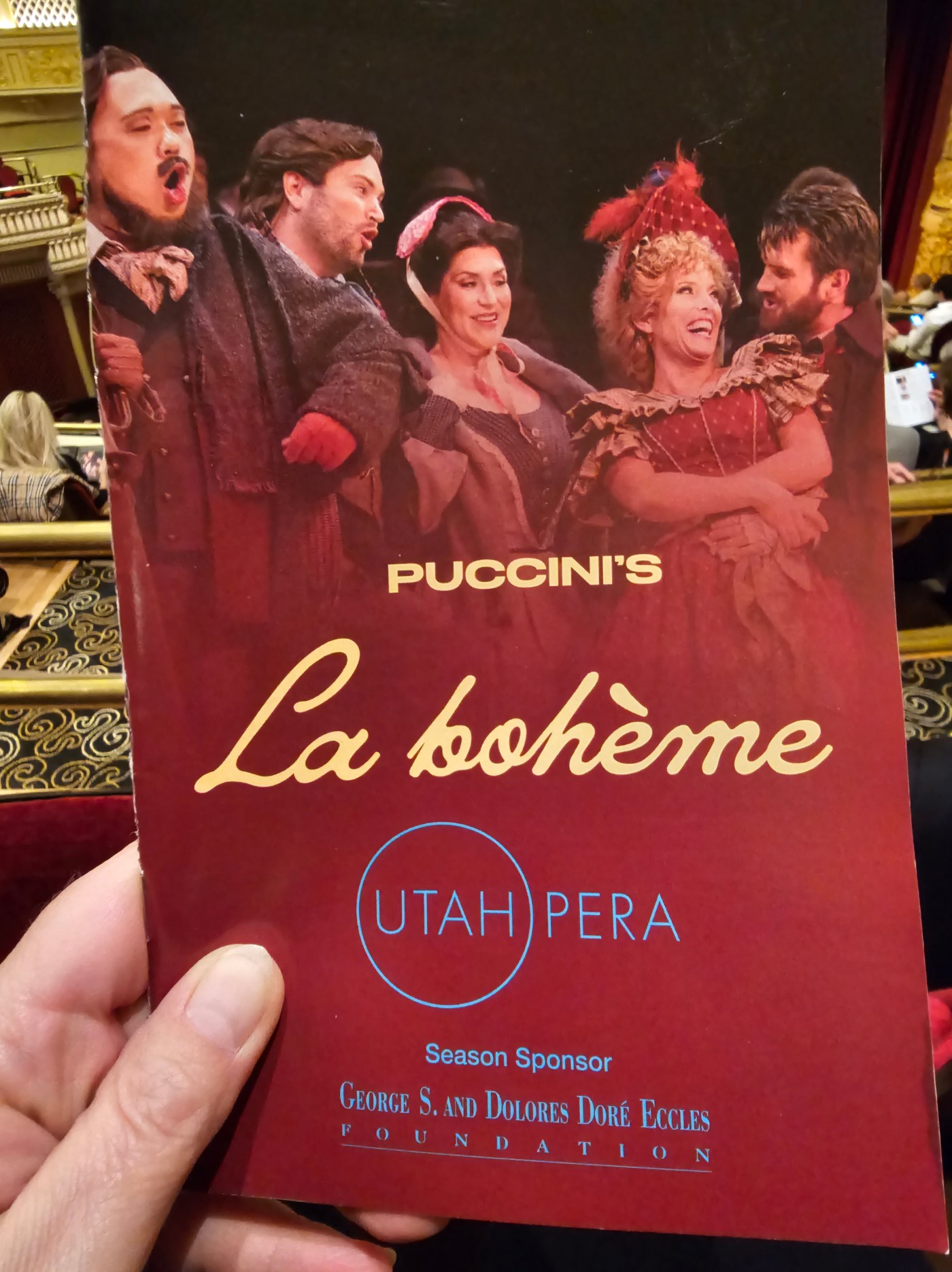
I saw Giacomo Puccini’s La bohème for the first time in October 2017 when Utah Opera staged a production to open its 40th season, giving a nod to the company’s first production of its inaugural season in 1978. I was a relatively new opera patron in 2017, slowly becoming familiar with key composers and their works. Specific details from that first time seeing La bohème are a bit hazy, but I do remember Jennifer Black’s poignant portrayal of the character Mimi — her resonant, clear voice and the deep emotion she conveyed.
Utah Opera again commences its season with La bohème, and I attended Wednesday night’s performance, going in with high expectations based on my first experience. This time, however, the rest of the cast shines in delivering dynamic, nuanced performances while Laura Wilde in the role of Mimi is much more reserved. She excels at portraying Mimi as modest and shy, making a quiet entrance. Unfortunately, though, she continues to sing much of her performance at the same volume as, or slightly quieter than, the orchestra, so her emotion and diction get lost in the power of Puccini’s score. While each artist approaches a role differently, I desperately wanted more from her performance; I searched for a sustained emotional connection that never fully materialized. Consequently, I turned my attention to the other members of the cast whose strong performances carry the show.
The action begins on Christmas Eve in a humble apartment in the Latin Quarter of 19th century Paris. Poet Rodolfo (Christopher Oglesby) and artist Marcello (James Westman) complain about the cold and burn one of Rodolfo’s manuscripts in their stove for heat. Philosopher Colline (William Guanbo Su) and musician Schaunard (Tshilidzi Ndou) arrive, bringing food, wine, and cigars, the fruits of Schaunard’s having worked an extra job. The bohemians engage in jovial, light-hearted banter that provides unexpected comic relief and serves as a counterpoint to the characters’ bleak circumstances and the tragic story that will unfold. (In a post-performance Q and A, Westman and Oglesby aptly described this banter as “shenanigans.”) Their landlord arrives to collect the rent, but they draw him into their revelry, and he leaves without receiving his money. While the friends descend to Café Momus downstairs to celebrate Christmas Eve, Rodolfo stays behind to work on his writing. A knock at the door interrupts him, and he discovers that it is his neighbor Mimi whose candle has burned out. While in Rodolfo’s garret, Mimi loses her key. (Rodolfo quickly finds, but also hides, the key to prolong his interaction with Mimi.) The two exchange life stories, and new love ignites.
In these opening scenes, Oglesby establishes himself as a tender, yet passionate, Rodolfo. He has an absolutely beautiful tenor voice whose warm tone and legato singing caress the notes and phrases. The fluidity of his movements on stage match the flow of his singing. His incredible delivery of the aria “Che gelida manina” elicited immediate well-deserved applause and “bravos” from the audience. Similarly, William Guanbo Su (bass) and Tshilidzi Ndou (baritone) as Colline and Schaunard possess deep, resonant voices and incredibly clear diction that made their performances a joy to hear.
The action continues in Act II with a fun, festive street scene outside Café Momus. Brightly colored costumes and sets as well as a full chorus give the audience a playful spectacle that I really liked. Rodolfo and Mimi join their friends, and the group gathers around a pair of café tables. Musetta (Marina Costa-Jackson) appears in a fantastic red costume and fluffy feather boa that hits everyone in its path as she flaunts her feminine charm and flirts with everyone in the café. Despite arriving with the wealthy Alcindoro (Danny Belcher), she manipulates and seeks the attention of her former lover Marcello, finally winning him over. Costa-Jackson brings a strong, yet warm, soprano voice and very crisp diction to her characterization of Musetta as a feisty flirt. I enjoyed her performance thoroughly. Additionally, strong singing from the male performers carries well above all of the activity happening in this act, and the physical humor in this act keeps the audience entertained.
Act III, set in February, presents trouble in Mimi and Rodolfo’s relationship. Mimi, who appeared frail in the first act, is suffering from deteriorating health and an increasingly frequent convulsive cough. She seeks out Marcello to confide in him that in spite of the love she and Rodolfo share, she can’t bear his incredible jealousy. Rodolfo also confides in Marcello, and Mimi overhears, that appearing to be jealous is merely a pretense. Rodolfo realizes that his meager means aren’t sufficient to care for Mimi’s failing health. If he can drive her away, a wealthier suitor can give her what she needs. The couple agrees to part without bitterness, but simultaneously, they can’t bear parting. They agree to stay together until spring. Oglesby delivers a particularly nuanced performance in his beautiful duet with Laura Wilde’s Mimi that reveals the depth of Rodolfo’s compassion. Wilde’s portion of the duet is an emotionally moving highlight in her otherwise reserved portrayal of Mimi.
In Act IV, the cast offers the audience a beautifully paced final scene that overflows with pathos. A more serious Musetta brings a weakened Mimi to Rodolfo’s garret for one last visit as they know Mimi doesn’t have much time. Looking to Musetta for guidance, the group of friends rallies around Mimi to care for her and give her and Rodolfo the gift of a few final moments. The cast conveys relatable, real emotion that keeps the audience spellbound until the end. William Guanbo Su sings a poignant rendition of the aria “Vecchia zimarra” in which his character Colline pensively articulates his decision to pawn an old coat in exchange for Mimi’s medicine. His reflection suggests that pawning the coat is about more than giving up a material object; it is about sacrificing a significant portion of oneself, possibly all that one has, to care for another. Wilde is at her best in this scene, deliberately pacing her lines to communicate Mimi’s emotions as she approaches and succumbs to death.
This production of La bohème beautifully explores themes of loving deeply and giving fully in spite of what one lacks. The group of friends, who may be seen as living on the fringes of their society, have little in material terms, yet they freely share and sacrifice to provide for each other. Like fires being kindled and candles being lit, human beings seek the spark, light, and warmth of genuine connection— and will do whatever it takes to keep that spark from going out too soon. Staging this opera now also seems appropriate as the story’s bleaker elements resonate with the real life challenges many people are facing around the world. Overall, the cast does a fantastic job bringing their characters to life and making the story’s messages accessible. I recommend seeing this production if you can.
Two performances remain, one on Friday evening and the final one on Sunday afternoon. Click here to purchase tickets and to learn more about Utah Opera’s 2023-2024 season.

 The Good Life
Leave a comment