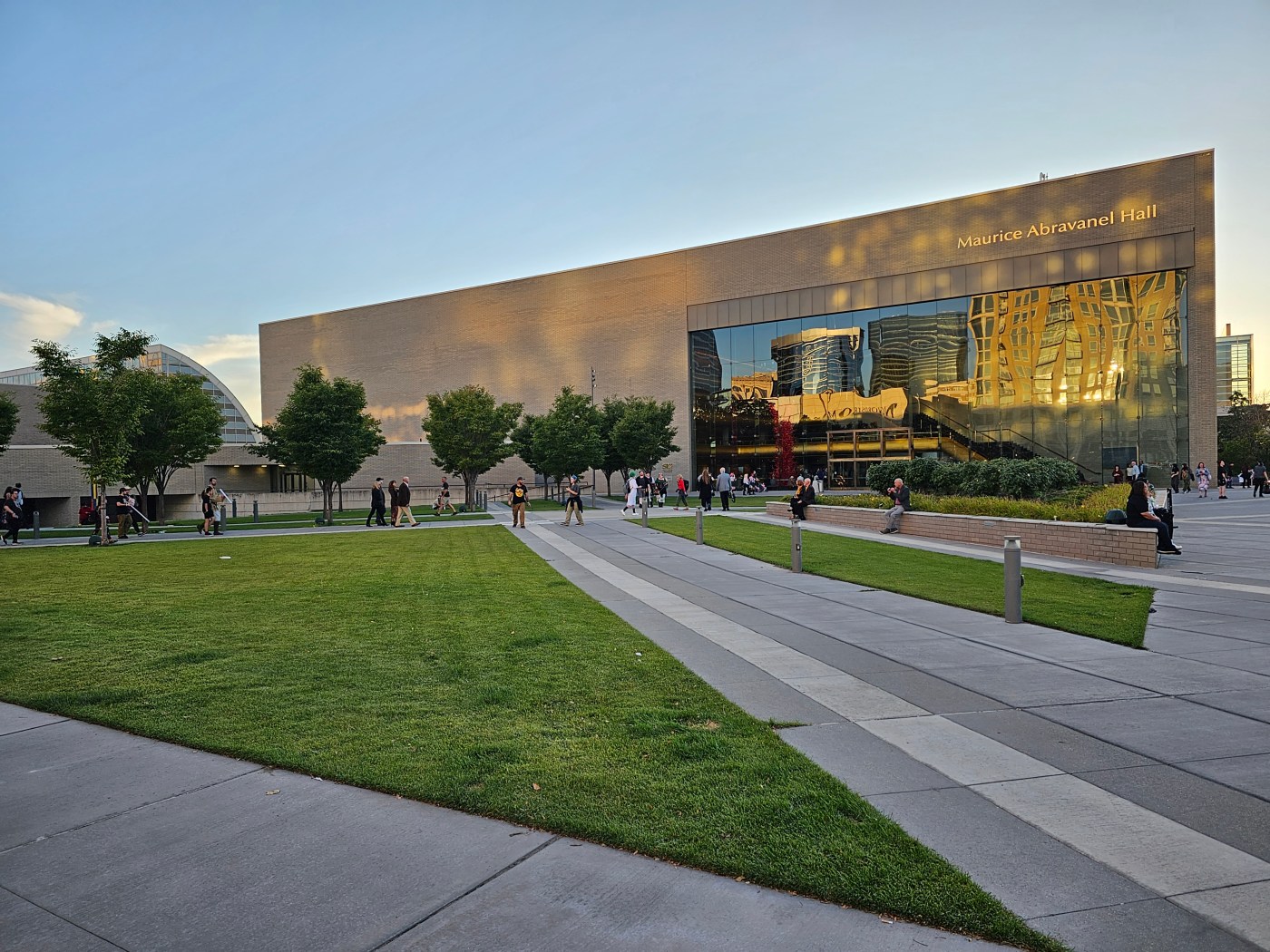
I attended Saturday night’s Utah Symphony concert which included Mozart’s Overture to Don Giovanni, K. 527, Beethoven’s “Emperor” Piano Concerto (Piano Concerto No. 5 in E-flat Major, Op. 73) , and Prokofiev’s Symphony No. 5 in B-flat Major, Op. 100. Even though I have a passing familiarity with all three composers, the music on the program was essentially new to me. I saw Utah Opera’s production of Don Giovanni in 2017, but I don’t know the opera well enough to have remembered the overture. Hearing it again as a stand-alone piece allowed me to focus on and enjoy its details. The Beethoven and Prokofiev pieces were completely new. One thing that I love about attending live performances, whether the music is classic or contemporary, is discovering pieces for the first time and letting the experience take me where it will. Sometimes I read about and listen to samples of the pieces and performers ahead of time; sometimes I don’t. That is a function of the busyness of life. I often enjoy just jumping in with both feet and letting the performance itself show me what the piece of music is. Whatever my prior familiarity, or lack thereof, with a particular composer or piece of music is, I love inhabiting the space of a student — an “amateur” in the original French and Italian senses of the word — who peels back the layers and delights in the novelty of the experience. Such was the case Saturday night, particularly with the Prokofiev symphony. As always, hearing live music provided a much-needed balm after a particularly stressful work week.
When shopping for a symphony ticket this time, I found an excellent price on a seat closer to the stage than where I usually sit. Thus, I sat in row seven on the left orchestra side, and this vantage point gave me an excellent view of the first violin section, the piano soloist for Beethoven’s concerto, and the conductor. Eduardo Strausser took the podium, and he appeared in the understated elegance of a black button-down shirt and black trousers — no tux with tails — and perfectly polished black patent leather shoes. While I don’t mind the formality of the “tux with tails” look traditionally associated with classical music performances, because dressing up can be fun, I also appreciate the ease of more casual, yet classy, styles because they make the performers and the music more accessible. Strausser conducted the program with a gentle touch, yet he also demonstrated and elicited the energy and passion that the music demanded. My close vantage point allowed me to see his facial expressions which communicated pure joy in the music he was conducting.
Mozart’s Overture to Don Giovanni opened the program. The piece begins with two dramatic, pulsing chords that demand the audience’s attention. These are contrasted with a lighter melody that follows. The lighter melody is both romantic and melancholic, and heavy chords soon interrupt its softness, creating a sense of doom. The piece evolves into crisp, well-articulated passages that are Mozart’s signature. These create images of a fast-past pursuit appropriate to Don Giovanni’s storyline. While I didn’t know this piece particularly well prior to Saturday night’s concert, I always love Mozart’s music. I found the overture to be a good warm-up, both for the orchestra and the audience, to the rest of the evening’s program.
Beethoven’s “Emperor” Piano Concerto (Piano Concerto No. 5 in E-flat Major, Op. 73) was the second piece on the program, and it featured soloist Marie-Ange Nguci at the piano. She gave the concerto’s three movements the nuances they required, alternating between precise, fast-moving scales and a lighter, more delicate touch for the piece’s softer, lyrical sections. This was particularly true of the allegro first movement which includes scales and powerful chords contrasted with tender passages. Nguci imbued the movement with a sense of joy and triumph. Her tender touch carried over into the adagio second movement which is very sweet and expressive. I also loved the last woodwind note of this movement, played by either an oboe or bassoon, that carried over into the start of the third movement because it created a sense of suspense about what would come next. That sense of suspense was satisfied in the final rondo-allegro movement whose melody is playful and fun.
Saturday night’s concert concluded with Prokofiev’s Symphony No. 5 in B-flat Major, Op. 100, which I found to be the most complex and intriguing piece on the program. Written in the summer of 1944 and first performed in January 1945, the piece aptly embodies the wartime turbulence that raged in the background of its creation. Prokofiev described Symphony No. 5 as “glorifying the grandeur of the human spirit” and “praising the free and happy man, his generosity, and the purity of his soul.” This symphony is in a major key, which at times signals joy, hope, and triumph; however, it also conveys ample amounts of melancholy. As the finale in Saturday evening’s program, it felt like the culmination of the intense emotion developed in the Mozart and Beethoven pieces, yet it also was a notable stylistic departure from them. Prokofiev’s symphony struck me as being unpredictable and less tidy than Mozart and Beethoven. It includes demanding passages for all sections in the orchestra, requiring everyone to play at full capacity. I enjoyed the entire program on Saturday night, but this piece engaged my attention more fully and held it until the end. Each movement contains elements worth noting.
- I. Andante – It is common for the first movement of multi-movement works to be a fast-paced allegro, so I was fascinated to hear that this symphony begins with a slower andante. The slower tempo does not compromise the intensity of the movement, however. It begins with a smooth woodwind melody that seems mellow and sweet, but it quickly evolves into a more chaotic, passionate piece that communicates both a sense of triumph and foreboding. The percussion and brass aptly remind the audience of the pulse of war in the background.
- II. Allegro – This movement differs from the first in that it is quick and spritely, teasing the audience with a delightful melody that resembles a “cat and mouse chase.” However, an undercurrent of dread remains.
- III. Adagio – The third movement initially offers calm after the storm with a string and woodwind melody, but even the calm is laden with sadness and doom. The movement soon becomes tumultuous. A snare drum keeps time, marking the steady beat that connotes wartime. Particularly high notes played by the first violins express the height of emotion.
- IV. Allegro giocoso – The final movement is lighter and more joyful than the previous three, suggesting that dread gives way to hope. Flutes, clarinet, and strings work together to create this happy finale.
Whether Utah Symphony’s programming is familiar or new, a night at the symphony is always a worthwhile weekend activity. Click here to learn more about the Utah Symphony and its upcoming performances.


 The Good Life
Leave a comment