
“A symphony must be like the whole world. It must contain everything.”
Gustav Mahler
The Utah Symphony’s performances on May 26-27, 2023 marked the end of an era: Thierry Fischer concluded his 14-year tenure as the organization’s Music Director. When the symphony selected Fischer in 2009, they gave him a clear directive and trusted him with the task of restoring a declining ensemble to its former position as a prominent regional orchestra. Fischer welcomed the challenge and the adventure, and the Utah Symphony thrived under his leadership. The symphony embraced bold programming and ambitious projects while making orchestral music more accessible to residents around the state. As a Utah Symphony patron, I enjoyed and appreciated his conducting style. He conducts with an easy, understated touch that places the music center stage and allows it to flow freely. I will miss his leadership, and I hope that in choosing a new Music Director, the Utah Symphony will build on Fischer’s legacy and style.
Thierry Fischer conscientiously chose Mahler’s Symphony No. 3 as the music for his farewell performances. Choosing this piece honored the Utah Symphony’s history of performing and recording Mahler’s work, a history that began under the leadership of Maurice Abravanel and which came to fruition in a two-year Mahler cycle celebrating the symphony’s 75th anniversary. A piece as grand as Mahler’s Symphony No. 3 also provided an opportunity for many musicians to gather on stage in a collaborative performance. The choristers of the Madeleine Choir School, the sopranos and altos of the Tabernacle Choir at Temple Square, and mezzo-soprano Anna Larson joined the Utah Symphony for this event.
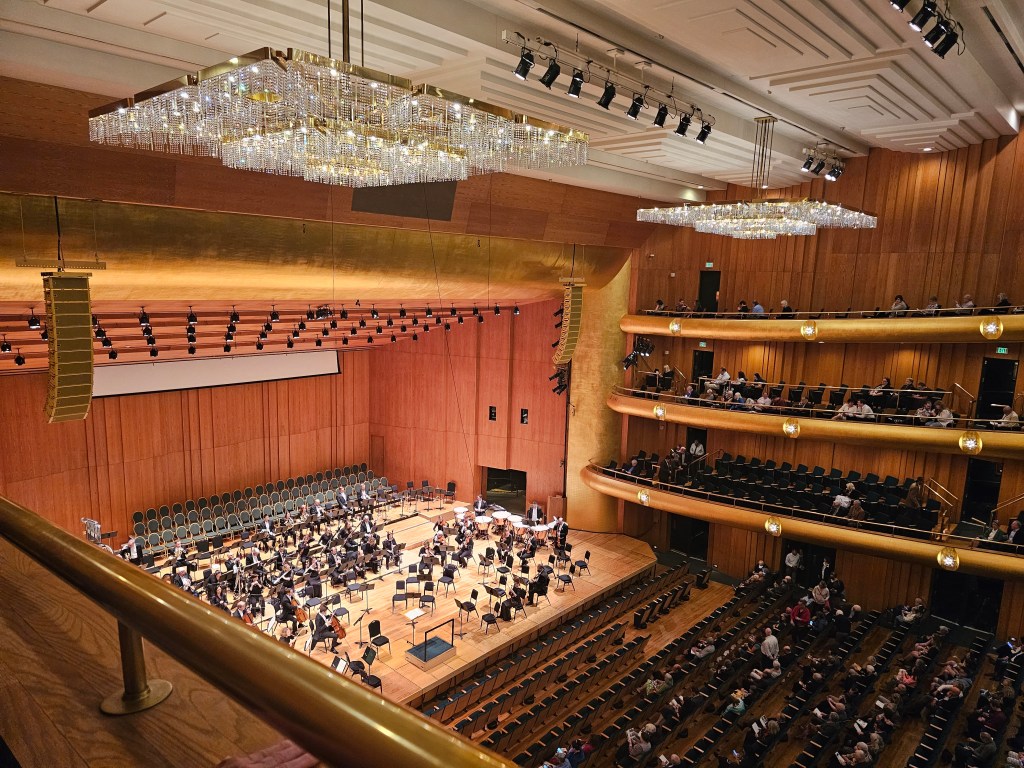
My friend Ruth and I attended the performance on Friday, May 26, 2023. Neither of us was familiar with Mahler’s Symphony No. 3 prior to this concert, but both of us found ourselves tremendously moved by the music and the performance.
Mahler’s Symphony No. 3 is the longest of his nine symphonies, lasting 92 minutes without intermission and including six movements. It fully displays his maximalist vision for orchestral music as the six movements seek to depict the creation of Earth and heaven. Mahler loosely titled each movement to communicate what the music was trying to convey although his titles were never officially published. I will use his titles in this review as that is the easiest way to describe the notable highlights from the evening’s performance. Similarly, reviewing a piece as comprehensive as Mahler’s third symphony in its entirety is a monumental task. With that in mind, I will focus this review on movements 1-3 and movement 6 because they contained elements that impacted me the most.
Mahler titled the first movement Pan awakes – Summer marches in. The brass and timpani sections dominated this movement, giving it a somber, foreboding quality. Occasional violin solos performed by concertmaster Madeline Adkins, sweeping string passages, and woodwind passages provided a counterbalance and lightened the heavy mood. As someone who used to play the violin, I thoroughly enjoyed the violin solos and string passages; those portions of an orchestral performance always resonate with me. I also noticed and really liked the trombone player’s smooth, soulful performance of his portions of this movement. It seems that music compositions, across different genres, feature the trumpet, so it was refreshing to hear the trombone played this way. Additionally, the French horn section, consisting of eight horn players, performed their passages in perfect unison, sounding as though they were one resonant voice.
The second and third movements, What the flowers in the meadow tell me and What the animals tell me, had a sweeter, more light-hearted sound, offering a noticeable contrast to the seriousness of the first movement. These movements highlighted the strings and woodwinds. The second movement featured the strings in passionate legato passages punctuated by faster moving sections. Concertmaster Madeline Adkins played several beautiful solos in this movement as well. The third movement continued with crisper, staccato notes that created a playful mood, aptly depicting the idea of animals dancing in the forest. This movement also included a post horn solo, a passage in which a trumpeter played a melody off stage that interacted with two French horns on stage. Playing off stage effectively put distance between the sound, the other musicians, and the audience — as if the intent were for the trumpeter to “call” creation to life. This portion of the third movement was particularly tender and ethereal. I found both of these movements to be charming and enchanting. They produced a sense of pure joy as I listened to them.
The sixth movement,What love tells me, began with an incredibly soft, gentle string passage that again included solos for the concertmaster. As the movement continued, the volume and intensity grew, and the brass and woodwinds complemented the strings’ melody. This led to a particularly triumphant ending. I closed my eyes during this movement to fully take in the sound without watching what the performers were doing. The music was thoroughly mesmerizing and transcendent.
The Utah Symphony’s performance of Mahler’s Symphony No. 3 successfully celebrated Thierry Fischer’s leadership of the organization. The performance embodied all that the conductor and orchestra accomplished together during his time here. It was definitely a fitting farewell and a tribute to a job well done.
 The Good Life
Leave a comment